


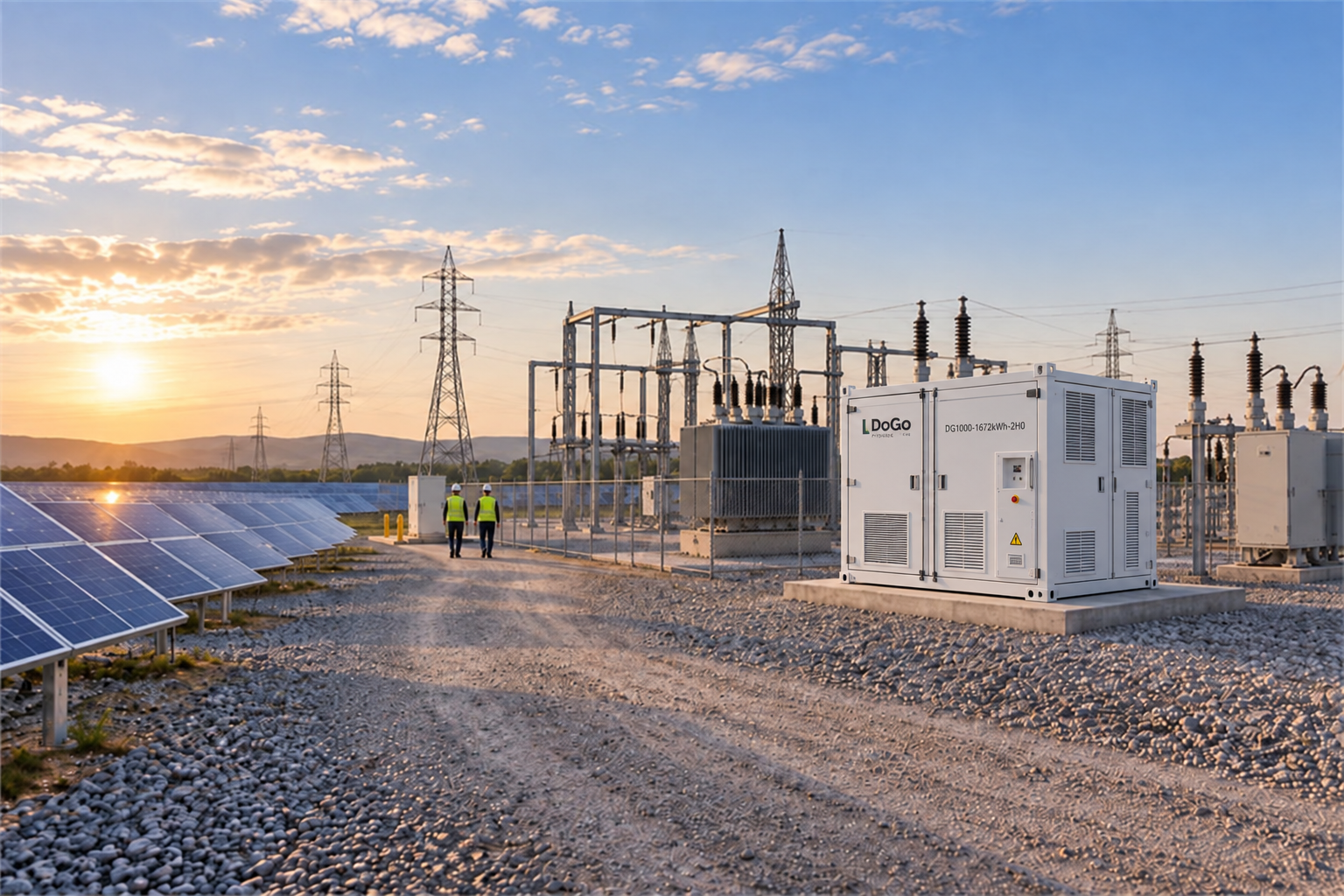
A Battery Energy Storage System (BESS) is a complete energy system that stores electricity in rechargeable battery cells and releases it later to a building, renewable-energy plant, microgrid, or utility network. A BESS is not the same as a battery bank or a UPS: the battery stores energy, while the complete system manages conversion, dispatch, monitoring, cooling, protection, and grid connection.
The word “system” is important. The U.S. Department of Energy identifies batteries, a battery management system, an inverter, switchgear, a transformer, protection equipment, and control systems as typical parts of a BESS.
At DoGo Power, we view BESS as a controllable power asset rather than a standalone battery. Its value comes from how effectively it stores, converts, dispatches, and protects energy in real operating conditions. Our 4S architecture extends this system-level view by coordinating EMS and BMS control functions with hardware-based PMS and PCS through a coordinated control architecture.
What does BESS stand for?
BESS stands for Battery Energy Storage System. At the system level, it refers to an integrated solution in which battery cells, modules, and racks work together with power-conversion equipment, control and monitoring systems, thermal management, protection, communications, and the equipment required to connect the system to site loads or the grid. Together, these components enable the BESS to store, convert, manage, and deliver electricity safely and reliably.
- Battery cells, modules, and racks: Store electrical energy electrochemically.
- Battery Management System (BMS): Monitors battery voltage, current, temperature, and state of charge; calculates operating limits and provides battery protection.
- Power Conversion System (PCS): Converts energy bidirectionally between DC and AC and controls active and reactive power.
- Energy Management System (EMS): Manages energy forecasts, charging and discharging schedules, operating strategies, and economic optimization.
- Power Management System (PMS): Coordinates real-time power flow among battery storage, solar PV, generators, loads, and the grid. It also manages plant-level power control and grid-connected or islanded operation.
- Thermal management and safety systems: Maintain suitable battery operating temperatures and provide fire detection, electrical protection, and fault response.
- Switchgear, transformers, and communication systems: Provide electrical connection, voltage conversion where required, protection, monitoring, and integration with the site or grid.
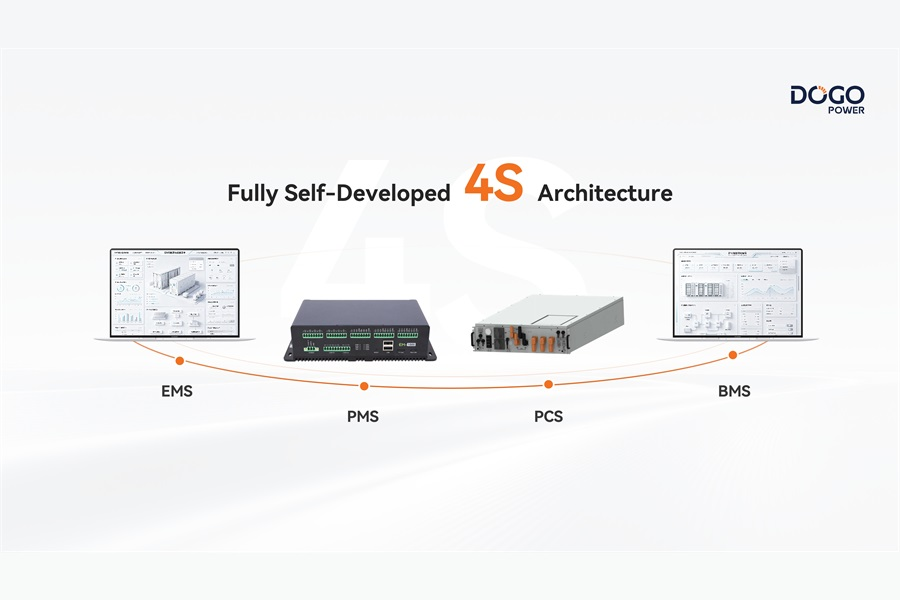
At DoGo Power, we design BESS as an integrated control architecture. Our in-house 4S grid-forming architecture coordinates EMS and BMS control functions with the PMS and PCS hardware, linking plant dispatch, battery operating limits, plant-level power coordination, and converter response. This architecture supports coordinated control and flexible adaptation across commercial and industrial facilities, mines, islands, microgrids, and utility-scale plants. Learn more in our 4S grid-forming technology overview.
Why is BESS important for modern power systems?
BESS makes electricity more flexible by separating the time when energy is produced from the time when it is consumed. Solar power can be stored during periods of high generation and used later. A commercial facility can charge during lower-cost periods and discharge during a demand peak. A utility can use battery storage to balance renewable generation and support grid operations.
The market is expanding quickly. The International Energy Agency’s 2026 Global Energy Review reports that 108 GW of new battery storage capacity was deployed worldwide in 2025, 40% more than in 2024. Around 80% of new battery capacity added in 2025 was utility-scale, while LFP batteries accounted for around 90% of deployments. The IEA notes that its 2025 values are based on Benchmark (2026) data.
This growth also shows why BESS design cannot be reduced to battery capacity alone. Power rating, duration, controls, safety systems, grid requirements, and the intended operating strategy all affect the result.
How does a battery energy storage system work?
- Charging: The BESS receives electricity from solar PV, the utility grid, wind generation, a generator, or another source. The PCS converts AC electricity to DC when required for battery charging.
- Storing: The battery stores energy electrochemically. The PCS manages charging power flow, the BMS monitors battery conditions and operating limits, and the EMS, PMS, thermal-management, and safety systems coordinate dispatch, plant operation, temperature control, and protection.
- Discharging: When the site or grid needs power, the battery releases DC electricity. The PCS converts it to AC electricity for building loads, a microgrid, or the grid.
- Coordinating: The EMS defines high-level operating objectives and schedules, while the PMS or plant controller converts those targets into real-time plant-level power setpoints within PCS and BMS limits.
Energy does not move through a BESS without losses. Conversion losses occur in the PCS and transformer, while cooling, controls, communications, and other auxiliary equipment consume part of the system’s energy. The energy delivered at the point of interconnection can therefore be lower than the battery’s DC nameplate capacity.
What are the main parts of a BESS?
Battery cells, modules, and racks
The battery stores energy electrochemically. Individual cells are assembled into modules, packs, and racks to achieve the required voltage and capacity. Lithium iron phosphate, or LFP, is widely used in current battery storage deployments. The right chemistry should be evaluated against energy density, safety, cycling, temperature, and commercial requirements.
Battery Management System
The BMS monitors battery conditions and helps keep the cells within permitted operating limits. It supports state-of-charge and state-of-health management, fault detection, balancing, and protective responses. At a larger scale, battery monitoring must work across cells, modules, racks, and the complete system.
Power Conversion System
The PCS is the electrical bridge between the battery’s DC output and an AC building or grid. It controls charging and discharging and may also support voltage regulation, frequency response, and grid synchronization, depending on its design and approvals.
Energy Management System
The EMS turns operating goals into dispatch decisions. It can coordinate PV, storage, loads, generators, tariffs, and grid signals. The software layer determines whether the system prioritizes self-consumption, peak shaving, backup reserve, energy shifting, or grid services.
Power Management System or plant controller
The PMS operates at the plant level. It coordinates active and reactive power targets, PV output, BESS charging and discharging, generator interaction, grid connection, and operating-mode changes. The term PMS is vendor- and project-specific; some suppliers use plant controller or power plant controller instead.
BMS, PCS, EMS, and PMS therefore have different responsibilities even though they must operate as a coordinated, hierarchical control system.
Thermal Management and Safety Systems
Battery performance and safety depend on more than temperature control alone. A complete BESS must also coordinate monitoring, electrical protection, ventilation, fire detection, and fire suppression as part of the overall system design.
For commercial and industrial facilities and microgrid projects, our DG1000-1672kWh combines an all-in-one 10-foot design with LFP batteries, liquid-cooled PCS, BMS, fire suppression, and liquid-cooled thermal management. The system is designed to support grid-connected, islanded, and microgrid operation.
Its published safety features include cell-level AI early warning for thermal runaway, active venting, pack-level aerogel isolation, and aerosol fire suppression. The system also supports AI-based optimization, PV, load, and tariff forecasting, as well as anomaly detection and early warning across multiple time scales.
These features are designed to improve system safety and operational visibility, but they do not eliminate thermal-runaway or fire risk. Actual performance depends on the selected configuration, site layout, local code requirements, commissioning, maintenance, and emergency procedures.
How are BESS power and capacity measured?
BESS specifications normally use two important measurements:
- Power, measured in kW or MW: How much electricity the system can deliver or absorb at a given moment.
- Energy capacity, measured in kWh or MWh: How much energy the battery can store.
Duration can be estimated by dividing energy capacity by power output. For example, a 1 MW / 2 MWh system has a nominal two-hour duration when operating at 1 MW. Delivered performance will vary with reserve settings, conversion losses, temperature, operating limits, auxiliary consumption, and battery degradation.
Our most important procurement recommendation is to compare the energy basis and delivery point, not just the headline MWh number. Use the following checklist when reviewing BESS proposals:
|
Metric |
Question to confirm |
|---|---|
|
Energy basis |
Does the quoted MWh refer to DC nameplate capacity, usable AC energy, or guaranteed energy at the point of interconnection? |
|
Round-trip efficiency |
What is the charge-and-discharge efficiency at the stated power, temperature, state-of-charge window, and auxiliary load? |
|
Degradation |
What capacity remains over time and energy throughput, and what operating conditions are assumed? |
|
Guaranteed output |
Is rated power measured at the PCS AC terminals or at the point of interconnection? What output is available continuously and during overload conditions? |
|
Operating envelope |
How do temperature, SOC reserve, altitude, cooling, and auxiliary consumption affect usable energy? |
|
Warranty throughput |
What energy throughput, end-of-life capacity, availability, and exclusions are included in the warranty? |
We developed EcoSizing to bring microgrid sizing and lifecycle analysis into the early design stage. The platform evaluates PV, storage, diesel generation, load data, and economic indicators to help us define an optimal system configuration before equipment is selected. Its workflow also covers lifecycle simulation, project economics. For projects at hundreds-of-MW scale, our solution design is intended to achieve CAPEX savings of more than 20% and shorten delivery timelines from one month to one week. Actual results depend on the project-specific conditions
What is BESS used for?
Solar and wind integration
BESS can store renewable energy when generation exceeds immediate demand and release it later. It can also help smooth output fluctuations, reduce curtailment, and improve the dispatchability of renewable plants.
Commercial and industrial energy management
Businesses may use commercial and industrial energy storage for self-consumption, peak shaving, demand management, time-of-use energy shifting, distribution capacity expansion, and backup power.
Project economics should be tested against four inputs: tariff structure, load profile, operating schedule, and market participation rules. A BESS with an attractive nameplate capacity does not automatically produce a positive financial outcome.
Microgrids and off-grid power
A BESS can coordinate with PV, diesel generators, and loads in a microgrid. With the appropriate inverter, controls, protection scheme, and operating reserve, it can support stable operation when the utility grid is unavailable.
Grid services
Utility-scale BESS projects can provide energy shifting, frequency regulation, operating reserves, voltage support, and other ancillary services. The IEA’s Electricity 2026 analysis identifies battery storage as an important source of short-term power-system flexibility.
Whether a project can earn revenue from grid services depends on local market access, qualification rules, required response speed, telemetry, power rating, and service duration.
What Is the Difference Between a Conventional BESS and a Grid-Forming BESS?
A BESS can operate in either grid-following or grid-forming mode. A grid-following inverter synchronizes with an existing voltage and frequency reference, while a grid-forming inverter can establish or actively support that reference within its designed operating range.
Our 4S grid-forming solution supports transfer between grid-connected and off-grid modes in as little as 20 milliseconds, frequency-oscillation suppression across a wide operating range, up to 150% transformer inrush-current tolerance, one-click black start, and smooth transitions between operating modes. Together, these capabilities help maintain stable and reliable power as grid conditions change.
By linking fast PCS response with PMS coordination and EMS dispatch, the architecture supports stable power delivery, renewable-energy integration, and coordinated backup or off-grid operation. Depending on the site and operating strategy, it can also help reduce renewable curtailment and diesel runtime.
Grid-forming technology serves as the core architecture of our commercial and industrial, utility-scale, mining, remote-island, new-urban-development, and microgrid solutions. Each configuration is matched to the project’s operating mode, load profile, grid conditions, and service requirements.
For a detailed comparison, read our grid-forming versus grid-following ESS guide.
How should you choose a BESS?
A practical BESS selection process starts with the operating problem, not with a preferred cabinet size.
- Define the objective: Decide whether the priority is backup, solar self-consumption, peak shaving, energy shifting, renewable integration, grid services, or microgrid operation.
- Measure the load: Review peak demand, average demand, critical loads, load duration, motor-starting events, and expected future growth.
- Set power and duration: Select the required MW or kW output and MWh or kWh capacity separately.
- Confirm the energy basis: Clarify whether the proposal guarantees DC capacity, usable AC energy, or delivered energy at the point of interconnection.
- Confirm the operating mode: Determine whether the system must operate grid-tied, off-grid, islanded, or in a hybrid microgrid.
- Evaluate integration: Check PV, generator, transformer, switchgear, protection, communications, PMS, and EMS compatibility.
- Review safety and compliance: Confirm applicable local regulations, interconnection rules, fire-safety requirements, environmental conditions, installation clearances, and maintenance procedures.
- Review lifecycle value: Compare degradation assumptions, round-trip efficiency, auxiliary consumption, warranty throughput, availability commitments, service capability, and total cost of ownership.
The DOE BESS procurement checklist recommends establishing technical and project requirements early, especially for commercial-scale lithium-ion BESS projects.
How We Apply BESS Technology
Once we establish an initial configuration, we validate power flows, protection settings, reserve strategy, and expected performance at the point of interconnection. This helps ensure that the proposed system is aligned with the project’s operating conditions.
For commercial and industrial projects, our C&I GFM ESS solution combines grid-forming storage, PV integration, and intelligent energy management in one coordinated solution. We support projects from system design and simulation through delivery and long-term operation and maintenance (O&M), helping customers move from initial planning to reliable operation.
For C&I sites that need an integrated and scalable storage platform, we typically start with the DG1000-1672kWh. The DG1000-1672kWh-2H0 uses LFP/314Ah batteries and provides 1,672 kWh of rated capacity, a 1,000–1,500 V battery voltage range, a maximum charge/discharge rate of 0.5 CP, and dual liquid cooling for the battery pack and PCS. Its integrated design helps simplify deployment and supports flexible PV-storage and microgrid configurations. We select the final configuration according to the site conditions, grid requirements, and project design.
Is BESS right for your project?
BESS is worth evaluating when a project has renewable-energy curtailment, high demand charges, time-of-use price differences, outage exposure, weak-grid conditions, or a need for flexible capacity. The right architecture follows the relationship between your load, generation, grid connection, operating objectives, and local requirements.
Share your project location, application, peak load, desired backup duration, renewable generation profile, and grid-tied or off-grid requirements when you contact our team about your BESS project. We can help identify an appropriate BESS architecture and determine which product and control strategy fit the project.
BESS FAQs
Is BESS the same as a battery?
No. A battery stores energy, while a BESS adds the conversion, control, protection, thermal management, and grid-connection equipment needed for complete operation.
How long does a BESS last?
There is no single lifespan figure for every BESS. Service life is influenced by battery chemistry, cycling, temperature, state-of-charge limits, energy throughput, operating strategy, and warranty conditions. Buyers should request degradation assumptions, guaranteed end-of-life capacity, and warranty throughput for the selected model.
What is the difference between BESS and UPS?
A UPS is primarily intended to bridge a power interruption for a short period. A BESS is typically configured as a programmable energy asset for applications such as energy shifting, peak shaving, renewable integration, backup, and grid services. The IEA notes that battery-based UPS systems generally provide short-duration backup until another source starts.


