


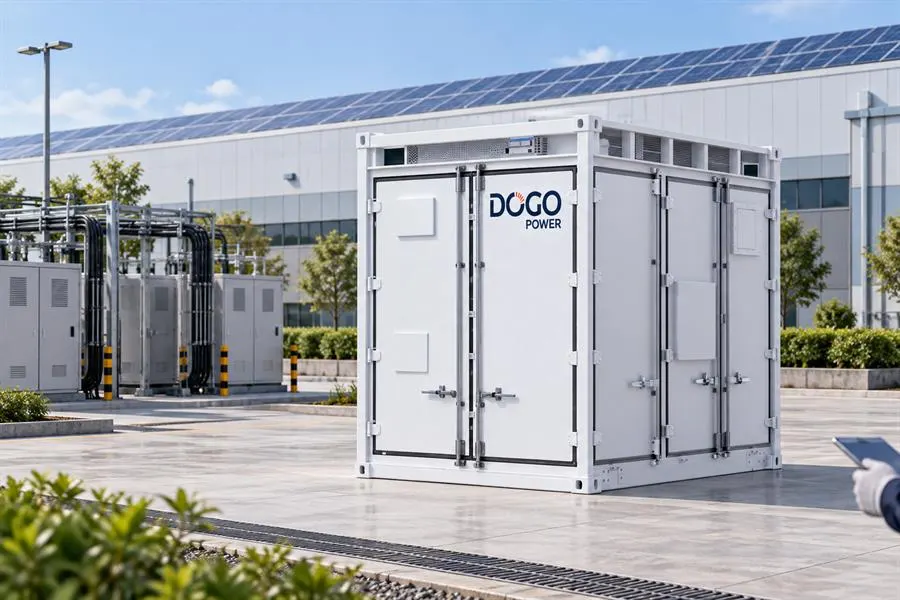
At DoGo Power, we define commercial and industrial (C&I) energy storage as a battery-based system that stores electricity and supplies it when a business can gain the greatest operational or economic value. Common applications include peak shaving, demand management, time-of-use energy shifting, solar self-consumption, backup power, power-quality support and microgrid operation.
A complete C&I energy storage system may include batteries, a battery management system, power conversion equipment, energy management software, protection devices, thermal management and microgrid controls. These components work together to manage charging and discharging, coordinate on-site energy resources and maintain safe operation. The main benefits include lower electricity costs, better renewable-energy utilization, greater power reliability and improved visibility into facility energy use.
What Does C&I Mean in Energy Storage?
In energy storage, C&I describes the application context rather than a specific battery technology. It refers to systems deployed at factories, industrial parks, warehouses, hotels, offices, retail facilities, campuses, EV charging sites, mines and other commercial or industrial facilities.
Compared with residential storage, C&I systems serve larger and more variable loads and are designed around demand charges, production schedules, critical equipment and business continuity. Utility-scale storage, by contrast, is primarily developed to provide grid-level services rather than meet the needs of a specific facility. Although the categories may overlap depending on project size and interconnection, a C&I system is typically designed around the site’s load profile, electricity tariff, operating schedule, PV generation, reliability requirements and grid conditions.
How Does C&I Energy Storage Work?
A C&I BESS charges batteries when electricity is less expensive, renewable generation is available or site demand is relatively low. It discharges when demand rises, tariffs increase, solar production falls or the facility needs support during a grid disturbance.
The control strategy uses site load, PV generation, battery state of charge, electricity tariffs and grid conditions. The system then determines when to charge, discharge, preserve reserve capacity or change operating modes.
Two measurements are especially important:
- Power capacity, measured in kW or MW: how much power the system can deliver or absorb at one time.
- Energy capacity, measured in kWh or MWh: how much energy the battery can store.
This power-versus-energy distinction is also reflected in the U.S. Energy Information Administration’s explanation of energy storage.
A peak shaving battery storage system may need high power output for a short period. A commercial battery backup system intended to support critical loads for several hours needs more usable energy capacity. Selecting only by kWh can therefore produce an unsuitable design.
C&I Energy Storage Architecture
One common C&I architecture uses an AC bus or point of common coupling (PCC) to connect the grid, PV inverter, PCS, generator and facility loads. Other projects may use DC-coupled arrangements, different voltage levels or multiple bus sections. Separate control layers coordinate these power assets.
Example AC topology: Grid, PV inverter, BESS PCS and generator connect to a common AC bus/PCC. Facility loads connect to the same bus.
| Layer | Main Components | Primary Function |
|---|---|---|
| Power Interface | Grid, PV inverter, BESS PCS, generator and common AC bus/PCC | Transfers and balances power between sources and facility loads. |
| Energy Storage | Battery cells, modules, racks and BMS | Stores energy and monitors battery safety, temperature and state of charge. |
| Facility Side | Production equipment, buildings, EV chargers and critical loads | Consumes electricity according to the site load profile. |
| Control Layer | EMS, PMS and microgrid controller | Forecasts, dispatches, balances power and manages grid-connected or islanded operation. |
PV may use an AC-coupled or DC-coupled arrangement. The appropriate choice depends on the PV system, PCS design, retrofit conditions, conversion losses, interconnection limits and project economics.
Battery System and BMS
The battery system includes cells, modules or packs, racks, battery management systems and protection equipment. The BMS monitors voltage, current, temperature and state of charge, then keeps the battery within its operating limits.
PCS and Real-Time Power Control
The power conversion system, or PCS, converts energy between DC battery power and AC facility or grid power. It executes active- and reactive-power commands and manages the electrical interface between the battery and the common AC bus.
EMS, PMS and Microgrid Controller
These control layers usually perform different functions, although their responsibilities may overlap:
- EMS: Handles PV and load forecasting, optimized dispatch, tariff-based operation, revenue analysis and reporting.
- PMS: Manages real-time power balance, executes power commands and coordinates connected devices within operating limits.
- Microgrid controller: Manages grid-connected and islanded operation, source-load-storage coordination, synchronization, transfer logic and protection sequences.
The exact responsibilities vary by vendor and system architecture. Our Energy Management and Control System supports centralized plant monitoring, PV and load forecasting, intelligent dispatch, historical data analysis and operational reporting. Our DG-SMC1000 Smart Microgrid Control Cabinet is designed for coordinated PV, BESS, diesel-generator and grid operation in C&I microgrid systems.
Thermal Management and Fire Safety
In our experience, battery safety is achieved through system-level engineering rather than cell selection alone. We evaluate thermal behavior, temperature and fault monitoring, ventilation, fire suppression, equipment spacing, emergency access and local approval requirements as part of the project design from the outset.
Our DG1000-1672kWh-2H0 is a 1,672 kWh all-in-one C&I BESS with a maximum charge/discharge rate of 0.5C. This gives the system a nominal operating duration of approximately two hours at a 0.5C rate, while actual runtime depends on the usable state-of-charge range, system efficiency, reserve settings and site load.
We combine an LFP battery system, BMS, PCS, EMS, pack- and PCS-level dual liquid cooling, cell-level AI early warning for thermal runaway, pack-level aerogel isolation and aerosol fire suppression in a containerized configuration. This integrated design reduces interface complexity while supporting intelligent monitoring, coordinated operation and a more controlled safety response. The platform also supports PV, ESS, EV chargers, gensets, loads and grid assets, with on/off-grid transfer in less than 20 milliseconds for projects that require microgrid resilience.
These integrated functions improve the system’s safety and operational flexibility, but they do not replace project-level engineering. We still assess site conditions, equipment layout, cabling, switchgear, electrical protection, emergency procedures, certifications and local regulations before installation. Procurement and commissioning should always follow the latest product datasheet and a project-specific safety review.
Main Applications of C&I Energy Storage
Peak Shaving and Demand Charge Management
Peak shaving uses the battery to reduce facility demand during high-load periods. The battery discharges when the site approaches a demand threshold, helping limit short-duration peaks that may increase the electricity bill.
This application is relevant for manufacturing plants, cold-storage sites, warehouses, hotels and EV charging locations. The financial result depends on the local tariff, demand-charge calculation method and dispatch accuracy.
Time-of-Use Energy Arbitrage
When electricity prices vary by time of day, a C&I BESS can charge during lower-cost periods and discharge during higher-cost periods. The control strategy should be configured around the actual tariff, including demand charges, export rules, standby charges and minimum-import requirements.
Solar Self-Consumption and Renewable Integration
Solar generation rarely aligns perfectly with a facility’s load profile. Our energy storage systems capture excess PV generation during periods of high solar output and discharge it when facility demand increases or solar production declines. This helps increase on-site solar self-consumption and reduce reliance on grid electricity.
By coordinating PV generation, battery charging and facility loads, we can smooth short-term fluctuations, reduce renewable curtailment and make better use of available solar energy throughout the day. This integrated approach enables commercial and industrial facilities to improve renewable-energy utilization while maintaining flexible and reliable operation.
Power Quality and Ancillary Services
Depending on the system design and local grid rules, storage may support frequency response, reactive power control, voltage support and power-factor management. These services require appropriate PCS controls, metering, protection, utility approval and system compatibility.
EV Charging and Integrated Energy Systems
EV charging can create sharp demand peaks, particularly when several high-power chargers operate together. A battery can limit grid demand, store solar energy for later charging and help manage transformer constraints.
Storage, PV and charging should be planned as one energy system. Charging schedules, vehicle availability, transformer capacity, site tariff and required charging speed all influence the final configuration.
Mali Factory Rooftop C&I Project
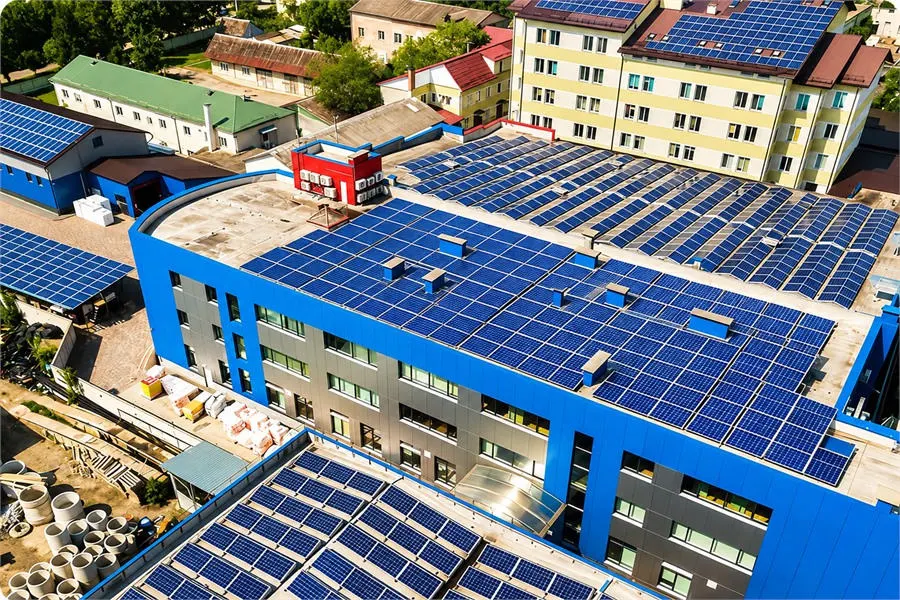
Our Mali factory rooftop project combines 5 MW of solar capacity with 10.72 MWh of energy storage in a C&I GFM Smart PV&ESS solution. By coordinating rooftop PV generation, battery storage and facility demand, the system has reduced electricity costs by approximately 30% and delivered annual carbon-emission savings of about 1,200 tons.
These results reflect the project’s load profile, PV output, tariff structure and operating strategy. When planning a new factory, we evaluate interval load data, demand peaks, storage duration, reserve capacity and interconnection conditions before estimating the expected ROI. Explore more applications through our Global Cases.
Benefits of C&I Energy Storage
The value of a C&I energy storage project should be measured against its operating objective. The following indicators help owners evaluate the business case without treating every application as identical.
| Benefit | Suggested KPI | Main Condition |
|---|---|---|
| Lower energy cost | Peak kW reduction, demand-charge savings and kWh shifted | Tariff structure, load profile and control accuracy |
| Backup reliability | Critical-load hours, ride-through time and transfer performance | Islanding equipment, reserve SOC, protection and critical-load design |
| Renewable utilization | Solar self-consumption rate and curtailed PV energy | PV output, facility load matching and export rules |
| Grid flexibility | Response time, reactive-power capability and supported operating modes | PCS controls, interconnection approval and grid conditions |
| Operational visibility | Data availability, alarm response time and reporting coverage | Metering, communications, EMS configuration and O&M processes |
Commercial Energy Storage Sizing
For commercial energy storage sizing, we start with the site’s operating objectives and load profile, then evaluate:
- Load profile: interval data, peak demand, load duration and critical-load requirements.
- Electricity tariff: energy charges, demand charges, time-of-use periods, export rules and standby charges.
- PV generation: solar production compared with daytime and evening consumption.
- Backup objective: which loads must remain online and for how long.
- Power quality: voltage, harmonics, power factor and phase balance.
- Site conditions: available space, ambient temperature, access, fire protection and noise requirements.
- Grid requirements: interconnection standards, protection settings, transfer logic and utility limits.
- Lifecycle economics: capital cost, operating savings, maintenance, degradation and expected cycles.
Safety Standards, Permits and Compliance Reviews
Safety and permitting requirements depend on the project location, system voltage, battery chemistry, installation environment, fire strategy, grid connection and authority having jurisdiction. A product datasheet is not a substitute for a project-level compliance review.
Depending on the target market, the design team may need to review standards such as IEC 62933-5-1 for safety considerations in grid-integrated energy storage systems and IEC 62619:2022 for industrial lithium cells and batteries. U.S. projects may also need to consider codes, standards and test methods such as NFPA 855, UL 9540 and UL 9540A, depending on the equipment and compliance pathway.
These references serve different functions. UL 9540 addresses energy storage system and equipment safety, while UL 9540A is a test method for evaluating thermal runaway fire propagation in battery energy storage systems.
Common project reviews may include electrical, building, fire, environmental and utility-interconnection approvals. Exact requirements must be confirmed with the local utility, permitting authority, fire authority and project engineer. Certification or test status should always be checked for the exact selected model and configuration.
Why Choose DoGo Power for C&I Energy Storage?
Commercial and industrial operators often need to solve several energy problems at once: high peak demand, unused solar generation, outage risk, complex power flows and limited visibility into daily operation. We combine storage hardware, power conversion, intelligent controls and lifecycle support to help owners manage these challenges through one coordinated energy system.
For distributed commercial sites such as retail facilities, hotels, community buildings and storage-charging projects, our DG1000-1672kWh-2H0 provides a containerized all-in-one storage option with battery, BMS, PCS, EMS, thermal management and fire-suppression functions in one configuration.
We support the project from design and simulation through delivery and operation and maintenance. This can help customers reduce configuration uncertainty, improve power-system coordination, monitor equipment remotely and adapt the system to changing load or renewable-energy requirements. Our Grid-Forming vs. Grid-Following ESS guide explains the key architecture choices for strong-grid, weak-grid and islanded projects.
FAQs
What is a commercial and industrial battery energy storage system?
A commercial and industrial battery energy storage system stores electricity and manages its use at a business or industrial site. It normally combines batteries, BMS, PCS, EMS, power controls, protection and thermal or fire-safety equipment.
How much does a C&I energy storage system cost?
There is no reliable universal price. Cost depends on power and energy capacity, duration, battery chemistry, PCS, controls, site works, transformer and switchgear requirements, fire protection, interconnection, installation and local labor. A project-specific design and commercial proposal are needed before quoting a price.
How is C&I energy storage ROI calculated?
C&I energy storage ROI should combine demand-charge savings, time-of-use savings, solar self-consumption, backup value and any approved grid-service revenue. The calculation should also include efficiency losses, battery degradation, maintenance, financing, replacement assumptions, interconnection costs and the expected operating schedule.
What is the difference between C&I and utility-scale energy storage?
C&I systems are typically designed around a specific facility, tariff, load profile and point of common coupling. Utility-scale systems are usually planned for grid-level services, generation shifting, transmission or distribution support. The two categories can share technologies, while their controls, interconnection studies, revenue models and operating priorities may differ.
Does every C&I project need grid-forming storage?
No. A strong-grid project focused on peak shaving or time-of-use arbitrage may use a grid-following configuration. Grid-forming capability is more relevant when the project requires islanding, voltage and frequency support, black-start capability, weak-grid operation or coordinated operation with generators and renewable sources.
What permits and safety reviews are required?
Requirements vary by jurisdiction and project design. A project may require electrical, building, fire, environmental and utility-interconnection reviews. The final checklist should be confirmed with the local authority, utility, fire authority and qualified project engineers.
Plan Your C&I Energy Storage Project
Every C&I project has its own load, tariff, reliability and grid requirements. We help translate those conditions into a practical storage architecture, capacity plan and operating strategy.
Contact DoGo Power to discuss your load profile, tariff structure, backup requirements and project goals with our energy storage team.


