


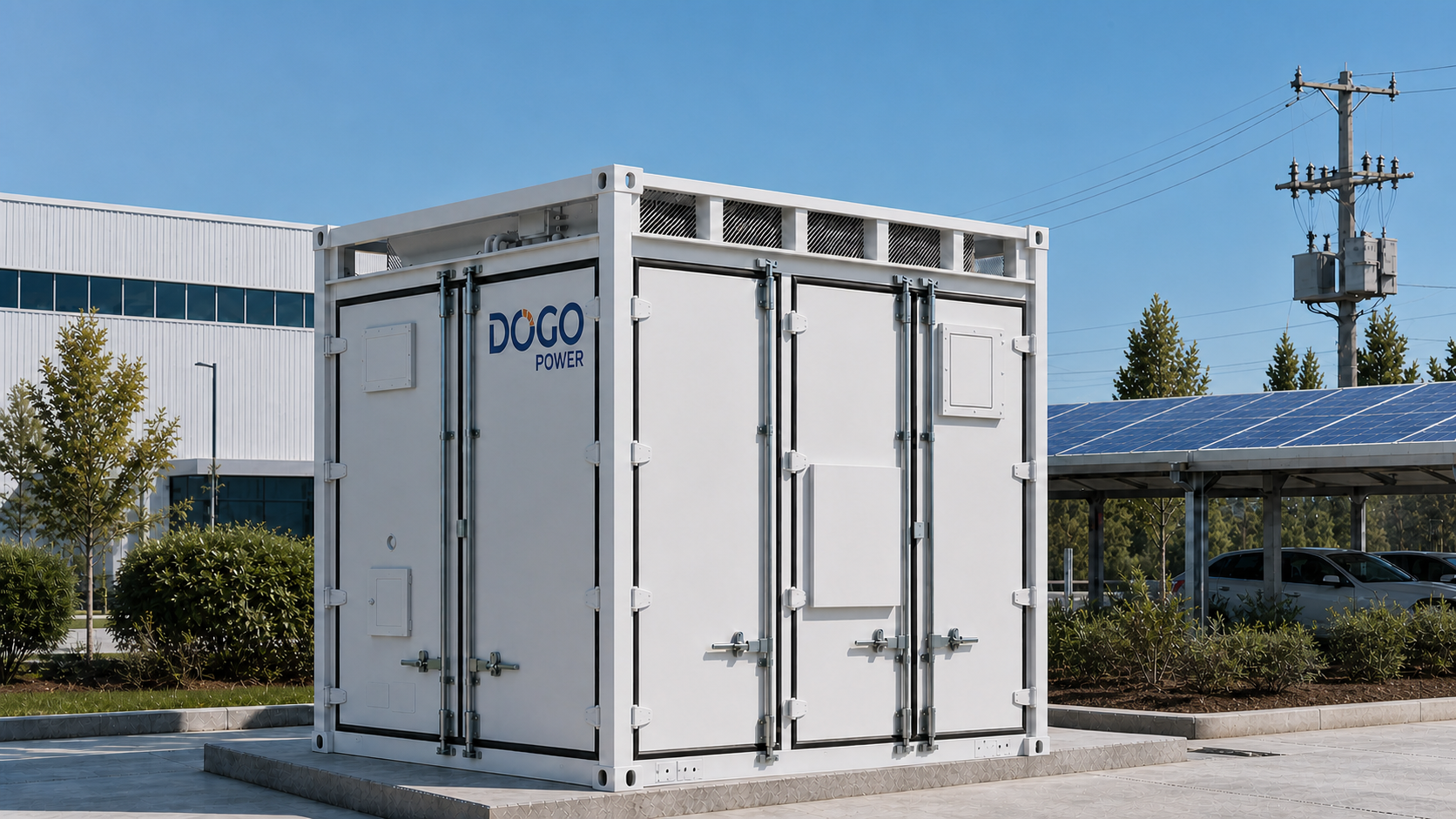
For weak-grid projects, selecting a grid-forming energy storage system is not simply about buying an energy storage cabinet. It means configuring a system that can establish voltage and frequency references. Storage hardware, PCS, BMS, EMS/PMS, system simulation, control strategy, grid-connected and islanded switching, black-start paths, and operation support all need to work together to reduce voltage fluctuation, frequency instability, oscillation, and power interruption risks.
The essential difference between grid-forming and grid-following energy storage is "who establishes the grid." A grid-forming ESS can actively form voltage and frequency references, making it suitable for weak grids, islanded microgrids, mining sites, islands, and high-renewable systems. A grid-following ESS needs to follow an existing grid, making it more suitable for peak shaving, grid dispatch, and energy shifting in strong-grid conditions. Weak-grid projects should prioritize grid-forming systems because the missing resource is often not energy capacity, but stable voltage, frequency, inertia, and damping.
What Is Grid-Forming Energy Storage?
Grid-forming energy storage is an energy storage system with active grid-building capability. Through the PCS converter and control algorithms, it actively forms voltage magnitude, frequency, and phase angle on the AC side, effectively providing a local grid with a voltage and frequency reference.
In simple terms, a grid-forming ESS does not wait for the grid to provide a reference. It establishes the reference first. Other PV inverters, wind converters, loads, diesel generators, or grid-following storage systems can then operate stably around that reference.
Grid-forming energy storage is suitable for:
- Off-grid or weak-grid projects such as mining sites, islands, and remote industrial parks;
- Microgrids that require seamless switching between grid-connected and islanded operation;
- Systems with high PV or wind penetration and fewer synchronous generators online;
- Industrial scenarios with obvious load impact that require fast voltage and frequency support;
- Projects that require black start, inertia support, oscillation damping, or ancillary-service capability.
What Is Grid-Following Energy Storage?
Grid-following energy storage depends on an existing grid reference. It first detects the voltage at the point of common coupling, uses a phase-locked loop (PLL) to identify grid phase and frequency, and then injects current into the grid according to active and reactive power commands.
The role of a grid-following ESS is closer to that of a "current follower." When the grid is strong enough and the reference signal is stable, it can perform peak shaving, demand management, electricity price arbitrage, and conventional grid-connected dispatch effectively. However, if the grid itself is weak, with large phase variation and frequent frequency disturbances, grid-following storage is limited by the quality of the external reference.
Grid-Forming vs Grid-Following ESS: Core Comparison
| Comparison Dimension | Grid-Forming ESS | Grid-Following ESS |
|---|---|---|
| System role | Actively establishes and supports the grid | Follows an existing grid |
| Equivalent characteristic | Controlled voltage source | Controlled current source |
| Voltage/frequency reference | Forms the reference internally and can provide the system benchmark | Depends on the external grid to provide the reference |
| Synchronization method | Uses the internal voltage phasor as the core reference, reducing or avoiding PLL dependence | Usually relies on PLL synchronization to track grid phase |
| Weak-grid adaptability | Strong; suitable for low SCR, low inertia, and frequent disturbance conditions | Weaker; the weaker the grid, the more likely PLL difficulty and control coupling become |
| Islanded operation | Can serve as the voltage and frequency reference for a microgrid | Usually cannot establish an islanded grid alone |
| Black-start capability | Can be designed to support black start and system restoration | Usually requires the external grid to recover before reconnecting |
| Typical applications | Weak grids, off-grid mining sites, island microgrids, high-renewable systems, and system-strength support | Strong-grid connection, peak shaving, energy shifting, and conventional storage dispatch |
How Grid-Forming ESS Works
The control logic of grid-forming energy storage is "form voltage first, then regulate power." The PCS establishes internal references for voltage magnitude, frequency, and phase angle, and behaves externally as a controllable voltage source. When load increases, grid disturbance occurs, or renewable output fluctuates, the system uses active and reactive power response to maintain voltage, frequency, and power balance.
From an engineering perspective, the value of grid-forming ESS is concentrated in four capabilities: first, providing a stable voltage reference; second, supporting frequency through fast active power response; third, suppressing oscillation through virtual inertia and damping; and fourth, maintaining islanded operation or participating in black start when the main grid is lost.
According to the NERC white paper Grid Forming Technology: Bulk Power System Reliability Considerations, GFM control is recommended for low system strength conditions and can provide voltage/frequency stability, small-signal damping, resynchronization, fault ride-through, and partial black-start capability. These are exactly the system services weak-grid projects need most.
How Grid-Following ESS Works
The control logic of grid-following energy storage is "lock phase first, then inject current." The PCS tracks the voltage phase at the point of interconnection through a PLL, then converts active and reactive power commands into current commands and outputs current to the grid.
In strong grids, grid-following storage is mature, relatively cost-controllable, and widely proven in grid-connected applications. In weak grids, however, the voltage at the point of interconnection is significantly affected by the storage system's own current injection. The reference signal seen by the PLL becomes less stable, which can lead to phase-tracking error, power oscillation, control interaction, and, in severe cases, protection trips or disconnection.
Therefore, grid-following storage is not "bad." It simply has a clear boundary: it requires an existing and sufficiently stable grid. A weak grid lacks exactly that stable reference.
Why Weak-Grid Scenarios Need Grid-Forming ESS
A weak grid does not simply mean low voltage. It means insufficient system strength. Common signs include low short-circuit capacity, low short-circuit ratio (SCR), high line impedance, fewer synchronous machines, low inertia, insufficient damping, and high sensitivity of point-of-connection voltage to power changes.
In Australia's NER S5.2.5.15, the minimum access standard for asynchronous generating systems requires stable operation and continuous connection at SCR 3.0. SCR has become an important screening indicator for weak-grid interconnection assessments. A low SCR does not automatically mean a project is infeasible, but it does mean conventional grid-following equipment must face higher risks related to PLL tracking, control coupling, and oscillation.
In weak-grid projects, the advantages of grid-forming energy storage mainly include:
- Reference establishment: When the grid reference is unstable, grid-forming ESS can actively establish voltage and frequency references.
- Voltage support: Through reactive power and voltage-source characteristics, it can reduce voltage fluctuation at the point of interconnection.
- Frequency stability: Through fast active power response, virtual inertia, and damping, it can reduce frequency deviation and RoCoF risk.
- Oscillation suppression: In multi-inverter parallel systems, it can improve equivalent impedance characteristics and reduce broadband or subsynchronous oscillation risk.
- Island support: After a main-grid fault, grid-forming ESS can maintain local microgrid operation and keep critical loads powered.
- Reduced diesel dependence: In mining sites, islands, and remote industrial parks, storage can provide fast dynamic support so diesel generators can operate more often as backup or within efficient operating ranges.
DoGo Power's Grid-Forming ESS Practice in Weak-Grid Scenarios
Weak-grid projects are usually not caused by a single issue. They often combine insufficient grid support, high diesel operating costs, PV output fluctuation, large motor-starting impact, and the need for continuous power to critical loads. When designing these solutions, we do not look only at storage capacity. We first assess on-site voltage references, frequency stability, load steps, diesel coordination, grid-connected and islanded switching, and black-start requirements, then determine the grid-forming capabilities the system must provide.
Take our Latin America mining microgrid project as an example. We provided a one-stop green mining microgrid solution covering multiple parts of the site's production energy demand. The mine had long relied on diesel generation and faced high fuel transportation costs, volatile generation costs, and insufficient power stability far from a strong grid. The project uses grid-forming energy storage to first establish stable voltage and frequency references, then coordinates PV generation, diesel generators, and the EMS energy management system so that storage can quickly support the system during load fluctuation while diesel generators operate more often in efficient ranges or as backup power.
This green mining microgrid solution can achieve more than 90% renewable energy substitution and save more than USD 1.5 million in fuel costs each year, while reducing carbon emissions and noise pollution and improving the on-site working environment. For mining customers, our value is not only lower electricity costs, but also reduced diesel transportation dependence, lower outage risk, improved power continuity for critical production loads, and reserved system space for future expansion of PV and other renewable energy.
For off-grid mining sites, weak-grid endpoints, island microgrids, and high-renewable industrial parks, our DG2000-2508kWh-2H0 grid-forming ESS can be deployed as a core device. The system supports stable independent grid formation, grid-connected/islanded switching, system-level black start, multi-timescale voltage and frequency stability control, and PV-storage-diesel coordinated operation, helping customers move from "diesel-dependent power supply" to "multi-energy coordination supported by grid-forming ESS."
Our value goes beyond equipment delivery. We integrate grid-forming energy storage products, EMS/PMS coordinated control, system simulation, project design, and operation support into a practical weak-grid solution. In the early project stage, we include SCR, load steps, diesel operating strategy, PV output curves, critical load levels, protection coordination, islanding switching, and black-start paths in the assessment to reduce the risks of oscillation, disconnection, and power interruption after commissioning.
DoGo Power Weak-Grid Solution Capabilities
From a project-delivery perspective, grid-forming ESS is not a single-device selection. It is a closed-loop combination of hardware, software, and services. The table below breaks DoGo Power's value in weak-grid projects into clearer capability layers.
| Capability Layer | What It Includes | Customer Value |
|---|---|---|
| Hardware foundation | DG2000-2508kWh-2H0 grid-forming ESS, PCS, and battery system | Provides grid-forming support and energy foundation for stable weak-grid operation |
| Control system | 4S coordinated control across EMS, PMS, BMS, and PCS | Enables voltage/frequency stability, grid-connected and islanded switching, black start, and PV-storage-diesel coordination |
| Planning and simulation | EcoSizing capacity planning, load curves, PV output, and SCR assessment | Avoids capacity-only selection and improves project ROI and reliability |
| Project services | System solution design, protection coordination, site commissioning, and commissioning verification | Reduces oscillation, disconnection, and power interruption risks |
| Lifecycle operation and maintenance | Operation monitoring, alarms, strategy optimization, and O&M support | Ensures long-term stable operation while continuously optimizing energy savings and power-supply benefits |
If your project is located at a mining site, island, remote industrial park, or weak-grid endpoint, or if you are evaluating a high-renewable grid connection plan, you can contact DoGo Power grid-forming ESS experts. We will configure a more stable and reliable grid-forming energy storage system based on on-site grid conditions, load curves, diesel generator configuration, and renewable energy output.
DoGo Power can also provide complete solution assessment from capacity planning, system simulation, and grid-forming control to project delivery and operation support.
How to Decide Between Grid-Forming and Grid-Following ESS
| Project Condition | Preferred Choice | Reason |
|---|---|---|
| Strong-grid connection, only for peak shaving or time-of-use arbitrage | Grid-following ESS | The grid reference is stable, and grid-following storage is mature and economical |
| Weak-grid endpoint with obvious voltage fluctuation | Grid-forming ESS | Active voltage support and oscillation damping are required |
| Off-grid operation in mining sites, islands, or remote industrial parks | Grid-forming ESS | Independent voltage and frequency references are required |
| Grid-connected operation that must switch to islanded supply after an outage | Grid-forming ESS | Grid-connected/islanded switching and island stability are required |
| High PV/wind penetration with fewer synchronous machines online | Grid-forming ESS | Additional inertia, damping, and system strength are required |
| Long-term diesel generator operation with fuel and maintenance reduction targets | Grid-forming or hybrid grid-forming ESS | Storage provides fast dynamic support, allowing diesel generators to operate as backup or within efficient ranges |
What Conditions Should Be Confirmed Before Deploying Grid-Forming ESS?
First, confirm the grid boundary, including the short-circuit ratio (SCR) at the point of interconnection, short-circuit capacity, line impedance, voltage fluctuation range, frequency of main-grid outages, and whether islanded operation is required. Weak-grid projects cannot be assessed only by grid-connection capacity. It is also necessary to determine whether storage must provide voltage and frequency support during main-grid disturbances.
Second, confirm the load boundary, including maximum load step, large motor-starting impact, critical load levels, allowable outage time, and restoration sequence. For mining sites, islands, and industrial parks, instantaneous load impact often determines PCS control strategy, storage power configuration, and protection coordination.
Third, confirm the energy boundary, including PV or wind output curves, diesel generator capacity and operating strategy, storage SOC operating range, and reserve capacity requirements. Grid-forming ESS is not a stand-alone device. It must form a stable closed loop with renewable generation, diesel generators, loads, and EMS/PMS control systems.
Finally, complete system-level verification before commissioning, including grid-forming control parameters, grid-connected/islanded switching logic, black-start paths, fault ride-through, protection coordination, and communication-abnormality scenarios. Only after these conditions are verified in advance can grid-forming ESS stably serve as the voltage and frequency reference in real weak-grid environments.
Conclusion: Weak-Grid Projects Should Prioritize Grid-Forming Capability
The key difference between grid-forming and grid-following energy storage is that grid-forming systems can actively establish the grid, while grid-following systems can only follow it. In strong-grid conditions, grid-following storage can economically perform conventional storage tasks. In weak-grid conditions, projects truly need voltage reference, frequency reference, inertia, damping, islanded operation, and black-start capability, which makes grid-forming energy storage better suited as the core solution.
In off-grid mining sites, island microgrids, remote industrial parks, high-renewable systems, and low-SCR grid-connection scenarios, selection should not compare only capacity and price. Grid-forming control, system strength, voltage and frequency stability, grid-connected/islanded switching, diesel coordination, and EMT simulation should all be included in the assessment.
FAQ
Why can't weak-grid projects use only grid-following ESS?
Grid-following ESS requires a stable external grid as its reference. In weak grids, voltage and phase can fluctuate, and PLL synchronization may experience tracking error and control coupling, leading to power oscillation or even disconnection. Grid-forming ESS can actively establish the reference and is better suited to system-stability roles.
Can grid-forming ESS fully replace diesel generators?
It depends on the load and energy structure. In projects with predictable loads and sustainable renewable energy replenishment, grid-forming ESS can significantly reduce or even replace diesel generator operation. For mining sites and large industrial loads, the more common preferred solution is coordinated operation between grid-forming ESS and diesel generators, with storage providing fast dynamic support so diesel generators spend less time in inefficient operation.
What is the most important factor in deciding whether a project needs grid-forming ESS?
Focus on SCR, short-circuit capacity, line impedance, load steps, renewable penetration, synchronous-machine online status, islanding requirements, black-start requirements, and oscillation risk. Final confirmation should be based on project-level simulation and site-specific operating strategy.


