


In weak-grid and off-grid projects, choosing a grid-forming energy storage system is not simply a matter of purchasing equipment. The project must address system sizing, EMS/PMS control, simulation verification, site commissioning, and long-term operations and maintenance at the same time. DoGo Power's 4S grid-forming technology system deeply integrates the four core systems of EMS, BMS, PMS, and PCS to improve both stability and economic performance.
For mines, islands, remote industrial parks, and renewable power plants, reliable power supply and lifecycle cost are not determined only by battery capacity or PCS parameters. What truly determines project performance is whether EMS, BMS, PMS, and PCS can form a closed loop across stable control, power dispatch, battery protection, and long-term O&M. In other words, the core of a weak-grid project is not merely pursuing technical stability, but managing stability, operational dispatch, and lifecycle cost within one coordinated system.
High Renewable Penetration Changes Where Stability Comes From
As renewable penetration increases, grid stability depends more heavily on system control. In the past, synchronous generators naturally provided inertia, primary frequency response, voltage support, and short-circuit capacity. Today, PV, wind power, and energy storage connect to the grid through power electronics, so these capabilities must be delivered through inverter control, protection settings, communication architecture, and plant-level dispatch.
In off-grid and weak-grid projects, this shift is even more direct. Large interconnected grids still have synchronous machines, cross-regional power balancing, and reserve resources to absorb local disturbances. Weak grids have far less buffering capacity, so voltage and frequency fluctuations can propagate to the load side more easily. Slow control response or weak equipment coordination directly affects power quality.
Grid rules are also moving in a more system-oriented direction. ENTSO-E's work on grid-forming requirements already covers non-synchronous generation and storage modules in Europe, while China's new power system plan for the 15th Five-Year Plan proposes reaching 300 GW of new energy storage by 2030 and supporting smart microgrids and coordinated dispatch. Rules vary by region, but the engineering direction is clear: stability needs to be built at the system level.
Weak-Grid Project Economics Also Need a System-Level View
The economics of weak-grid projects cannot be evaluated only by the price of energy storage cabinets, conversion efficiency, or unit capacity. When we design a solution, we look first at the total lifecycle cost picture.
- Initial investment: how much energy storage, diesel generation, and redundant capacity are needed to achieve the same reliability target.
- Fuel cost: how long diesel generators operate, at what load rate they run, and what it actually costs to deliver fuel to the site.
- O&M cost: inspections, spare parts, fault response, labor, and remote operations capability.
- Residual value: long-term battery operating conditions, depth of cycle, and SOC range affect the project's value in later years.
These cost items are interconnected. Optimizing one piece of equipment usually improves only one metric. To reduce redundancy, cut diesel runtime, improve availability, and control battery degradation at the same time, the project needs to start from system configuration, control strategy, and operational dispatch together.
| Project Perspective | Device Parameters Only | Integrated Software-Hardware Solution |
|---|---|---|
| Stability | Focuses mainly on individual PCS or battery performance. | Evaluates PCS response, BMS limits, PMS coordination, and EMS dispatch together. |
| Economics | Costs are spread across equipment procurement, fuel, O&M, and battery lifetime. | Calculates CAPEX, fuel, O&M, and residual value together through sizing, simulation, and operating strategy. |
| Delivery Risk | Control-interface and protection-logic issues often surface only during site integration. | Completes solution evaluation, simulation validation, and control-strategy matching during the design stage. |
Why Grid Forming Must Be Coordinated as a System
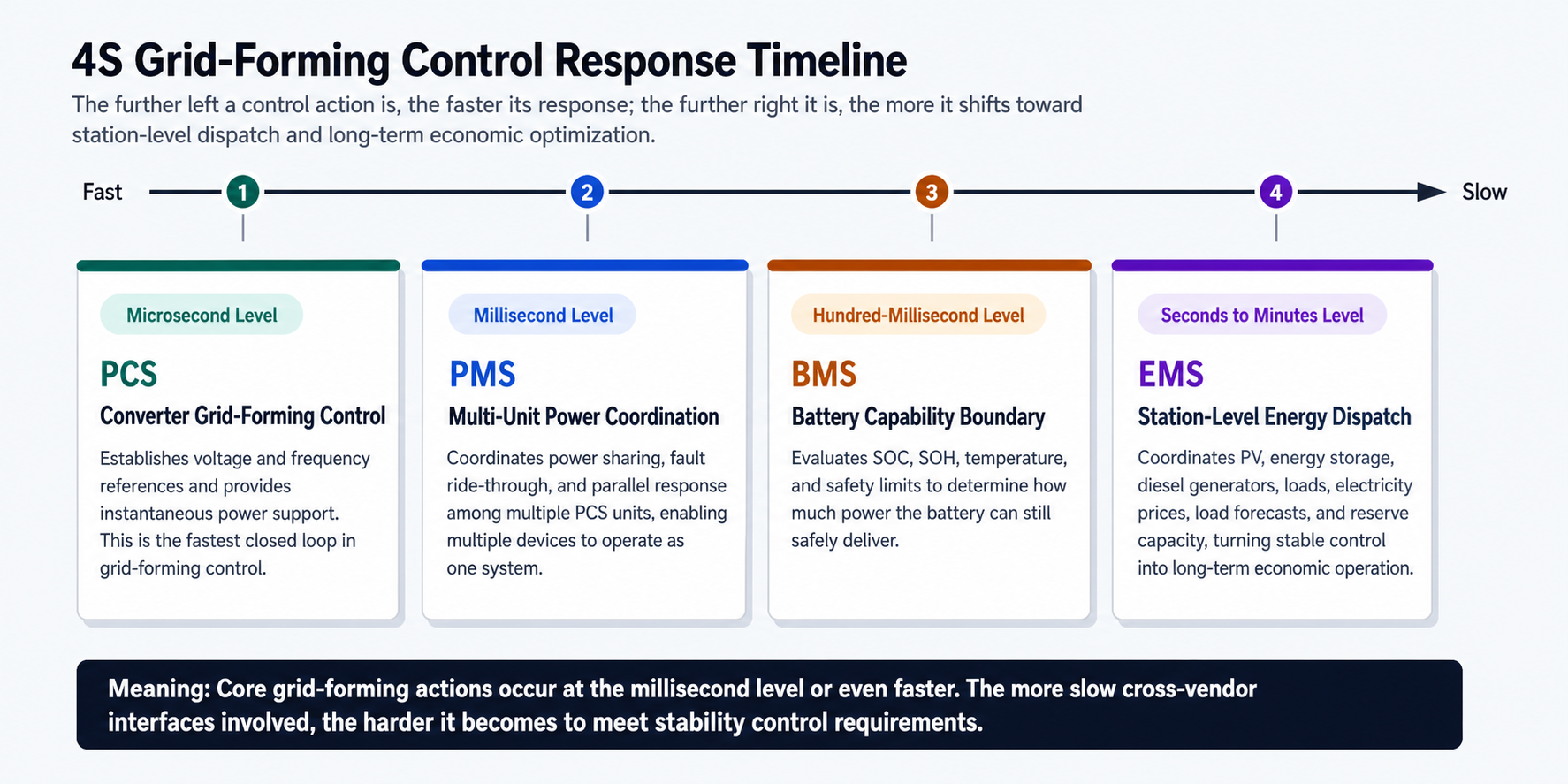
Grid forming must be coordinated as a system because the key capabilities do not reside only in the PCS. Voltage establishment, frequency support, inertia response, fault ride-through, black start, and diesel substitution all require PCS, PMS, BMS, and EMS to operate within the same set of boundaries across different time scales.
The advantage of synchronous machines is that these capabilities are concentrated in the same physical structure. Inertia comes from rotor mass, voltage support from excitation, short-circuit capacity from the electromagnetic structure, and frequency response from the governor system. This gives synchronous machines a natural basis for coordination.
Power electronic systems distribute these capabilities across different devices, control layers, time scales, and suppliers. Stability depends on whether the control strategy is correct and whether each layer coordinates in time. Economics lands in the same place, because investment, fuel, maintenance, and battery residual value are spread across different subsystems.
The CAISO, NERC, and WECC staff report on inverter-based resource disturbances in the Western Interconnection provides an important warning. The report reviews four Western Interconnection events in 2024: after normally cleared faults, inverter-based resources reduced active power output by 1,046 MW, 532 MW, 698 MW, and 934 MW respectively, with the largest event involving 37 units.
This shows that insufficient coordination can evolve into system-level risk. The issues described in the report involve firmware or software updates, inverter protection settings, interconnection protocols, and model-related processes. For weak-grid projects, where there is no large grid behind the site to absorb disturbances, this kind of risk can propagate into field operation more quickly.
From System-Level Problems to the 4S Grid-Forming Technology System
The 4S architecture puts plant dispatch, battery boundaries, power coordination, and converter response into one operating framework. EMS determines how the plant operates, BMS defines how much capability the battery can safely deliver, PMS coordinates power at the plant level, and PCS provides fast conversion and grid support. In this way, grid forming shifts from a set of dispersed device functions into coordinated and verifiable system behavior.
DoGo Power's 4S grid-forming technology system integrates EMS, BMS, PMS, and PCS into a software-defined energy architecture. Its advantage is that stable control and lifecycle economics can be handled through the same logic. For off-grid and weak-grid projects, this helps reduce cross-supplier conversion, shorten response paths, and verify system behavior before deployment.
In real projects, we use the energy management control system for PV and load forecasting, intelligent dispatch, and plant monitoring. It helps the project decide when to charge, when to discharge, when to retain battery reserve, and how to reduce diesel-generator runtime. We use the power management system to translate dispatch targets into plant-level power behavior, coordinating GFM PCS, voltage and frequency regulation, PV generation, BESS charge and discharge, diesel-generator interaction, and multi-source energy flow.
BMS is responsible for keeping the battery within safe boundaries. By monitoring voltage, current, temperature, SOC, and SOH, it determines how much capability the battery can safely release under different operating conditions. PCS provides bidirectional power conversion and grid support during disturbances. In the 4S architecture, PCS response, PMS coordination, BMS boundaries, and EMS dispatch targets are connected, so fast support and long-term operation follow the same control logic.
At the product-planning level, we first match products to the project scenario. For C&I and microgrid projects, we focus on evaluating DG1000-1672kWh-2H0 for scenarios that require grid-connected/off-grid operation, PV-storage coordination, and local load management. For utility-side projects, we combine the Utility-Scale GFM Smart BESS Solution with priority evaluation of DG2000-2508kWh-2H0 for large-capacity energy storage, grid-forming support, and plant-level dispatch. During actual selection, we consider the load curve, grid strength, operating mode, and simulation results to ensure the product configuration aligns with the project goals.
How Stability and Economics Improve in the Same Direction
When stability and economics are planned through the same architecture, the two can improve in the same direction. In weak-grid projects, excessive redundancy drives up cost, while excessive reserve reduction weakens system resilience. Through coordinated control, we retain enough support for disturbances while reducing unnecessary capacity, diesel-generator runtime, and operational waste.
This is also why we build the Utility-Scale GFM Smart BESS Solution. Through lifecycle design, simulation, optimization, and management, we evaluate system performance before equipment deployment and connect design, control, and operation within one project process. According to our published solution data, this approach supports more than 20% CAPEX savings, shortens the delivery cycle for 100 MW-class projects from one month to one week, and improves solution availability and reliability through design, simulation, delivery, and O&M processes.
These figures are based on our solution design and delivery scope. They point to system value: better economics do not come from a single equipment parameter, but from coordination among design tools, simulation capability, control strategy, delivery preparation, and O&M processes.
For C&I projects, we apply the same system thinking through the C&I Grid-Forming Energy Storage Solution. We focus on reliable power supply, PV-storage coordination, peak-valley operation, demand response, and remote O&M. In scenarios with stronger grid conditions, it helps improve energy management and power-supply reliability. In weak grids, the same coordination becomes even more valuable because external support is more limited.
Mining Microgrid Grid-Forming Energy Storage Case
Mining microgrids are well suited for validating the value of grid-forming ESS because they test power-supply stability, fuel substitution, equipment coordination, and long-term O&M at the same time. In the Latin America mining microgrid grid-forming smart PV-storage power station case, we adopted a microgrid grid-forming smart PV-storage solution to help the project achieve a green-power substitution rate of more than 90%, save over USD 1.5 million in fuel costs each year, reduce carbon emissions and noise pollution, and improve the on-site operating environment.
The value of this project does not come only from energy storage capacity. What truly works is the energy closed loop formed by PV, energy storage, diesel generation, battery management, power coordination, and dispatch strategy. For mines, islands, and remote power plants, one delayed dispatch decision, an overly conservative battery boundary, or uncoordinated protection settings can turn into additional fuel cost, downtime, or battery stress.
System Lessons for Off-Grid and Weak-Grid Projects
Grid-forming energy storage should be selected and designed as a complete control system. PCS capability is important, but it can fully take effect only when it works together with PMS coordination, BMS battery boundaries, and EMS economic dispatch.
For off-grid and weak-grid projects, stability cannot be left to a large public grid as a backstop, and economics cannot depend on unlimited standby generation. We start with an assessment of weak-grid conditions, design the right ESS configuration, integrate EMS/PMS control, and verify system stability through simulation to ensure the solution can support project delivery and long-term operation.
FAQ
What is 4S grid-forming technology?
4S grid-forming technology is DoGo Power's Self-Developed architecture that integrates four Systems — the Energy Management System (EMS), Battery Management System (BMS), Power Management System (PMS), and Power Conversion System (PCS) — into a single control framework. By emulating the operating characteristics of a synchronous generator through algorithms, it establishes voltage and frequency references independently, allowing energy storage to support weak grids and operate off-grid.
Can grid-forming energy storage operate without a strong public grid?
Yes, provided it is designed as a complete power system. Grid-forming energy storage can support voltage and frequency during off-grid operation, but black start, inrush current, available battery energy, and protection settings still need to be designed in a unified way.
What is the difference between a grid-forming inverter and a conventional inverter?
A grid-forming inverter can establish voltage and frequency references. A conventional grid-following inverter usually relies on an existing grid reference, so it may not be able to stably support a weak grid or islanded system on its own.
Can grid-forming energy storage reduce diesel-generator runtime?
Yes, if dispatch and reserves are coordinated properly. Energy storage can carry part of the load, absorb renewable fluctuations, and retain disturbance reserve, but the result depends on EMS dispatch, PMS power coordination, BMS boundaries, and battery operating conditions.
Sources
- ENTSO-E: ENTSO-E publishes Phase II technical report on grid-forming requirements
- ECNS: China's new energy storage capacity to reach 300 GW by 2030 under new power system plan
- NERC/WECC: Inverter-Based Resource Disturbances in the Western Interconnection


