


A compliance and project-impact guide for European storage developers and asset owners
The practical answer for 2026 is clear: EU-wide grid-forming requirements are moving toward formal adoption, while national grid codes and project-specific connection conditions are already shaping storage design. As of November 10, 2026, the European Commission text revising the Requirements for Generators code remains a draft, and ENTSO-E’s technical report is nonbinding guidance. Portugal has already published grid-forming and synthetic-inertia requirements for storage connected to its transmission system. For developers and asset owners, grid-forming capability now belongs in early connection strategy, technical specifications, EPC scope, warranty discussions, and the financial model. The key is to identify the project category, define plant-level performance, and reserve enough time and commercial headroom to prove compliance. For BESS developers, grid-forming readiness is not simply a matter of selecting a compatible inverter. It requires a coordinated system design that aligns converter controls, battery operating limits, energy management, protection, and plant-level performance.
1. Where Do ENTSO-E’s Grid-Forming Requirements Stand in 2026?
The EU framework is advanced, but a single effective rule does not yet cover every member state. ENTSO-E published its Phase II technical report on grid-forming requirements in November 2025. It describes functional performance, testing, and implementation considerations while confirming its nonbinding status.
The regulatory route runs through the revised Requirements for Generators network code. Its draft provisions cover power park modules and storage power park modules. As of November 10, 2026, EUR-Lex still presents the text as a draft act. Final obligations depend on adoption, transition rules, national implementation, and each connection agreement.
National action is already visible. In October 2026, Portugal announced grid-forming operation and synthetic-inertia requirements for storage connected to its transmission grid. Developers should expect the EU code to set direction while TSOs and national authorities define connection criteria, parameters, studies, and tests.
Treat grid-forming readiness as a current development issue. Waiting for the final legislative step can leave a project with fewer choices in its connection study, procurement package, or control architecture.
2. Which EU Storage Projects Fall Within the Scope of the Requirements?
Scope depends on project type, size, voltage level, connection date, and the relevant system operator’s decision. The Commission draft places the clearest obligations on new Type C and Type D storage power park modules. For Type B storage, mandatory capability is linked to specified thresholds, including units connected at 110 kV or above and units of at least 10 MW connected through a dedicated feeder to a 110 kV-or-higher substation. Other Type B projects may be brought into scope through national roadmaps and system-need assessments.
The draft generally applies the new technical provisions to relevant facilities connected 24 months after entry into force. A project reaching financial close earlier may still commission after that threshold and need compliant equipment, models, and test plans.
Existing assets may be affected through a cost-benefit-based extension of requirements, major modernization, converter replacement, or a material connection change. Repowering and augmentation deserve attention because an expansion can change fault behavior, controls, protection coordination, and accepted evidence.
For a quick scope screen, place the project in one of four groups:
- New transmission-connected BESS or Type D storage: highest likelihood of mandatory grid-forming capability.
- New Type C storage: high likelihood under the draft EU structure.
- Type B storage at high voltage or at least 10 MW on a dedicated high-voltage feeder: direct draft trigger.
- Existing, augmented, or substantially modified storage: case-specific exposure through national rules and connection changes.
3. Which Storage Projects Are Most Likely to Be Affected?
Projects in weak-grid and high-inverter regions will face the earliest and most demanding scrutiny. System operators are most concerned where conventional synchronous generation is retiring, short-circuit strength is low, renewable penetration is high, or several large inverter-based plants share the same grid corridor.
Large standalone BESS, co-located renewables, island systems, and projects near constrained substations are likely candidates. Merchant projects can also be affected because grid-forming operation may require state-of-charge reserve, active-power headroom, or converter capacity that interacts with dispatch.
The distinction between grid-forming and grid-following ESS explains the concern. A grid-following converter synchronizes to an existing grid waveform, while a grid-forming converter can establish and regulate voltage and frequency. However, grid-forming capability at the BESS level extends beyond converter control. Effective grid-forming operation requires coordinated performance across the PCS, battery system, BMS, EMS, plant-level controls, and protection systems. These components must work together to deliver stable and reliable responses under different grid and operating conditions.
Our published Latin American mining microgrid is a useful system-level example. Its grid-forming BESS coordinates solar, diesel units, and mine loads in islanded operation, supporting more than 90% renewable substitution and reported annual fuel savings above US$1.5 million. This is an operating reference, not an EU grid-code certificate; it shows the value of stable voltage-source behavior and coordinated controls.
4. What Will Developers Need to Specify and Demonstrate?
Developers will need to specify measurable plant behavior and demonstrate it with models, studies, and commissioning evidence. The term “grid-forming ready” is too broad for a bankable contract unless the required functions, operating envelope, interfaces, and acceptance criteria are written down.
A practical specification should cover voltage-source behavior, active and reactive response, frequency and voltage support, synthetic inertia where requested, stable operation across the agreed short-circuit-ratio range, fault ride-through, current limiting, recovery, and operating-mode transitions. It should define available response at different state-of-charge levels and ambient conditions.
Grid-forming compliance is a system-level responsibility, not simply a PCS feature. Although the PCS provides the core grid-forming control functions, the actual performance of a BESS depends on coordinated operation across the PMS, PCS, BMS, and EMS, together with the protection system and other supporting components.
While the PCS delivers the required voltage-source behavior and dynamic response, the other systems work together to manage energy availability, operating conditions, system-level coordination, and safety. Therefore, selecting a grid-forming-capable PCS does not automatically ensure that the entire BESS meets project-specific grid-forming requirements.
Evidence should form a chain: validated RMS and EMT models, parameter documentation, power-system studies, hardware-in-the-loop or factory evidence where required, site tests, and final model reconciliation. The connection agreement should allocate each model, control-parameter authority, and the result that governs acceptance.
For projects requiring coordinated source-grid-load-storage operation, our 4S grid-forming architecture illustrates how PMS, PCS, BMS, and EMS work together to support system-level grid-forming performance.
Rather than treating grid-forming as an isolated converter function, the 4S architecture emphasizes coordinated control, power conversion, battery management, and energy management to enable stable and reliable operation under different grid conditions.
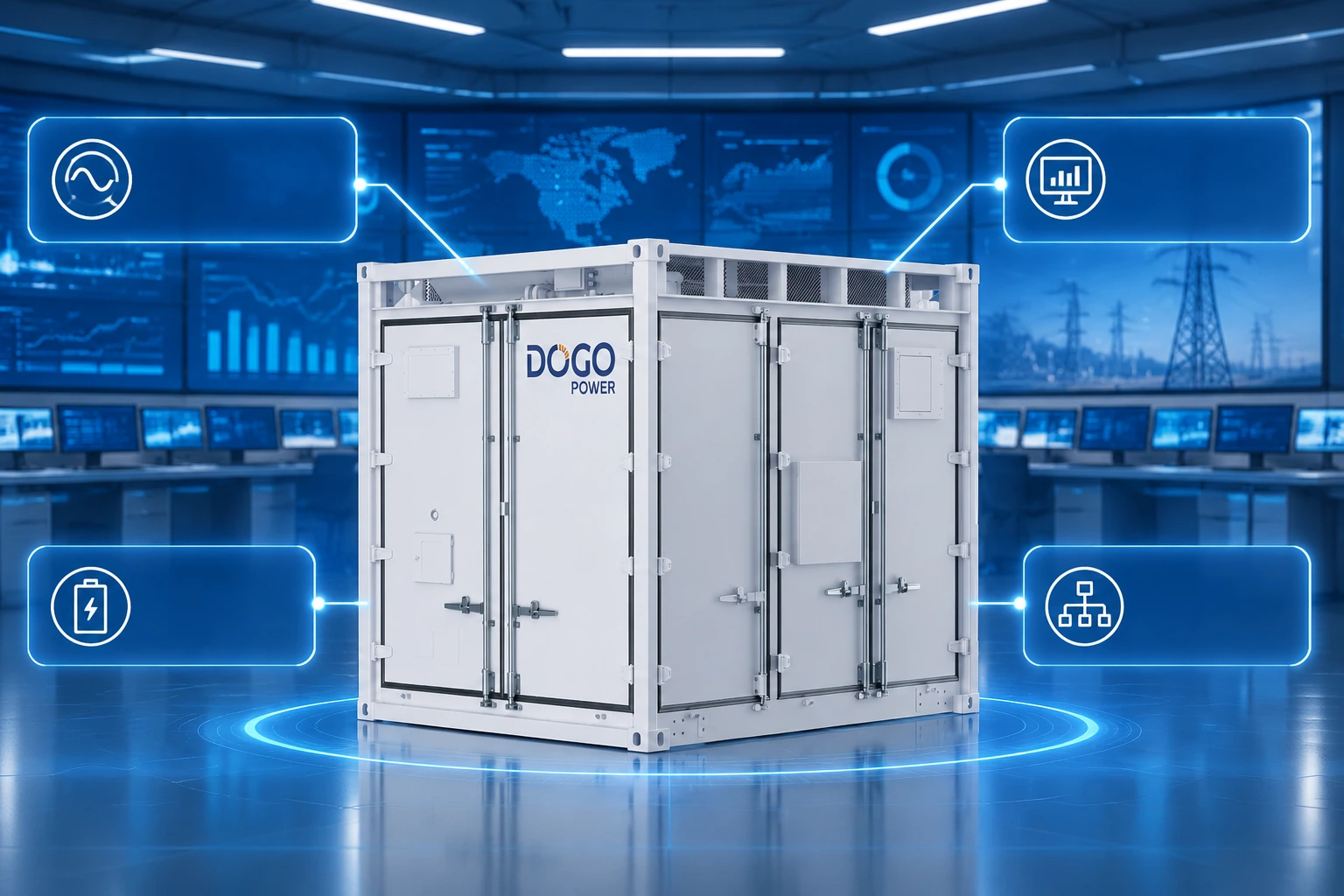
The following DoGo Power platforms show the range of system building blocks that can enter a project design:
Both the DG1000 and DG2000 platforms embody DoGo Power's "1 ESS, 1 Microgrid Ready" concept. By integrating the essential grid-forming components and coordinated control systems within a single cabinet, each unit can independently establish and support a local grid without requiring additional external power conversion or control equipment, apart from the necessary transformer.
5. How Could Grid-Forming Requirements Affect Project Cost, Schedule, and Returns?
The largest commercial effect may come from integration and operating assumptions beyond the converter price. The cost impact of grid-forming requirements extends beyond PCS hardware and control software. Because grid-forming performance depends on the coordinated operation of the entire BESS, developers must also consider system integration, battery operating limits, EMS and plant-controller coordination, protection design, communication interfaces, and system-level validation.
These requirements can increase engineering complexity, integration costs, and commissioning effort. They may also affect operating strategies, including available power headroom and state-of-charge management. EMT studies, model validation, factory tests, and witnessed commissioning add specialist work.
Capacity allocation also matters. Reserved active-power headroom or a state-of-charge band can reduce energy available for arbitrage. Reactive-power and disturbance-response duties may constrain export if the converter is sized only for the original dispatch case. These effects belong in the revenue model before bids and financing terms are locked.
Schedule risk often sits between companies. The PCS supplier provides a model, the integrator configures the plant controller, the EPC owns protection settings, and the developer carries the connection milestone. Late model revisions or failed tests can delay energization. Responsibility matrices, model dates, parameter controls, and test procedures reduce that exposure.
The return can still be attractive. Grid-forming capability may protect connection access, support resilience, reduce curtailment or diesel dependence, and open future ancillary-service revenue. The case becomes stronger when connection security and flexibility are valued alongside energy-market income.
For larger C&I and microgrid applications, our DG1000-1672kWh Super All-in-One ESS combines a 1,672 kWh LFP/314 Ah battery system with a 1,000–1,500 V battery voltage range, a maximum 0.5 CP charge/discharge rate, and dual liquid cooling for the battery packs and PCS. Its integrated architecture is designed to coordinate PV, storage, EV chargers, gensets, loads, and grid connections, with on/off-grid transfer in under 20 ms for sensitive loads. For utility configurations, the DG2000 utility GFM ESS platform provides modular 1,672, 2,090, and 2,508 kWh options. These product references help frame architecture and sizing conversations; the final compliance package remains tied to the project’s grid requirements and test plan.
6. What Should EU Developers and Asset Owners Do Next?
The next step is to move grid-forming decisions ahead of equipment tendering. Screen the country, system operator, voltage, draft project category, energization date, system strength, and national roadmap. Translate the result into the employer’s requirements and connection-study scope.
Then align the commercial documents. Procurement specifications should define not only PCS grid-forming functions but also the system-level performance requirements, control interfaces, integration responsibilities, and validation procedures across the complete BESS. The EPC contract should allocate models, studies, protection coordination, testing, parameter management, and delay responsibility. Warranties should address both equipment limits and the operating modes used to meet the grid code. The financial model should reflect reserved headroom, state-of-charge constraints, study costs, and schedule contingency.
We recommend a staged evidence plan: agree the model format early, freeze the control basis before final studies, review interfaces before factory testing, and design commissioning tests while site and grid access remain flexible.
Grid-forming requirements are becoming part of the investment case for European storage. Developers who define the obligation early can compare suppliers on evidence and system performance, preserve negotiating leverage, and protect the connection program. That is the point at which our engineering team can add the most value: translating grid behavior into a workable BESS architecture and a clear package of responsibilities.
Frequently Asked Questions
Are ENTSO-E grid-forming requirements legally binding in 2026?
ENTSO-E’s 2025 technical report is nonbinding. Binding obligations arise through EU regulation after adoption, national rules, and project-specific connection agreements. As of November 10, 2026, the Commission’s revised NC RfG text remains a draft.
Will every new EU battery project need grid-forming capability?
No single rule currently captures every battery project. The draft places the strongest requirements on Type C and Type D storage, specified Type B projects, and other projects identified through national implementation. Voltage, size, connection arrangement, timing, and system need all matter.
Can grid-forming capability be added later through a software update?
Not necessarily. While grid-forming control algorithms may be implemented through software or firmware upgrades on compatible PCS platforms, achieving grid-forming capability at the BESS level requires more than converter control.
Effective grid-forming operation depends on coordinated performance across the PCS, battery system, BMS, EMS, plant-level controls, and protection systems. Whether an existing BESS can be upgraded depends on its original system architecture, hardware capabilities, control compatibility, and integration requirements.
Any upgrade must also be validated through system-level testing to demonstrate the required grid-forming performance and compliance with applicable grid codes.
What evidence will a TSO usually expect?
The exact package varies, but developers should prepare for validated RMS and EMT models, control descriptions, study results, OEM data, factory or hardware-in-the-loop evidence where requested, site tests, and an agreed process for reconciling the final model with commissioned settings.
How early should a developer include grid-forming requirements in procurement?
Include them before the PCS and system integration scope is tendered. Early definition allows bidders to price the same performance envelope, model package, testing duty, and warranty responsibility, which makes commercial comparisons far more reliable.
Conclusion
For European storage projects, grid-forming capability is becoming a system-design decision that influences grid connection, equipment selection, technical studies, operating strategy, and long-term project value. Developers can reduce uncertainty by defining performance requirements early, aligning the PCS and plant controller architecture, and treating models, testing, warranties, and operating limits as part of one compliance package.
When you are evaluating a new BESS project, reviewing grid-forming requirements, or preparing a technical specification for a European connection process, the DoGo Power team can help translate project requirements into a practical system architecture. Explore our grid-forming BESS solutions and energy storage engineering support to discuss the next stage of your project.


