


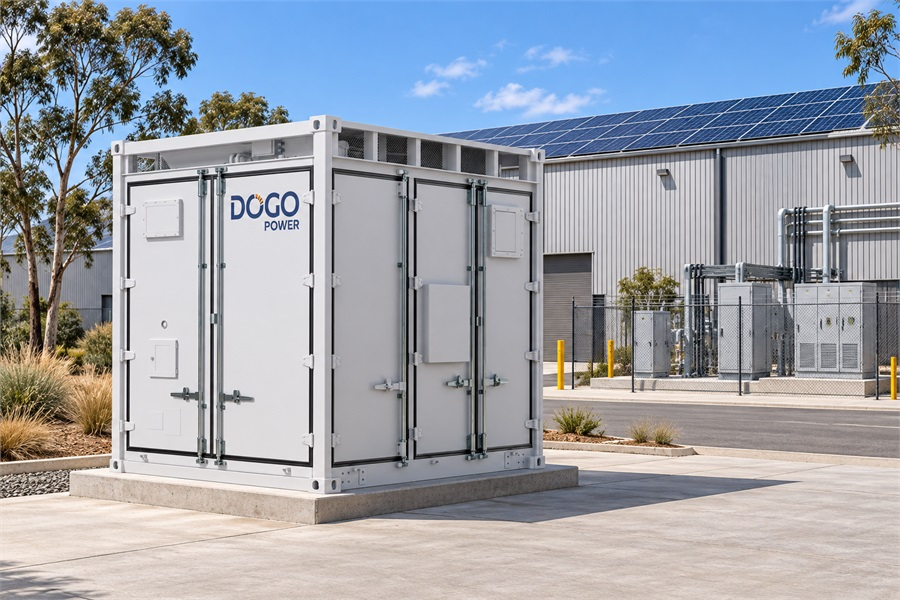
Grid-forming battery energy storage systems (BESS) are becoming a grid-stability priority as projects need voltage and frequency support alongside stored energy. For commercial and industrial (C&I) facilities and microgrid buyers, the immediate question is how the proposed system will respond to a weak-grid connection, a supply interruption or a major load change.
The April 2025 blackout in Spain and Portugal shows how gaps in voltage control can contribute to a much larger outage. For storage buyers, that makes disturbance response part of planning from the start.
At DoGo Power, we provide grid-forming energy storage solutions for C&I facilities and microgrids, built on our self-developed 4S Grid-Forming Technology. Our support covers design and simulation through delivery and operation, helping owners assess how a proposed system will respond to supply interruptions and changing loads.
Enough Energy Does Not Guarantee a Stable Grid
A power system can have enough generation and stored energy while still struggling to maintain a stable electrical waveform. Energy adequacy asks whether supply can meet demand over time. Stability asks whether connected equipment can remain synchronized and recover when a generator trips, a line disconnects or a large load changes.
Synchronous machines contribute rotational inertia, voltage support and substantial fault current. Replacing their energy output with solar, wind and batteries does not automatically reproduce those characteristics. Inverter controls and protection arrangements determine how the replacement resources interact with the network.
The exposure also changes throughout the day. A connection that operates comfortably with several synchronous units online may face different conditions when renewable output rises and those units reduce production or disconnect. Annual renewable percentages alone cannot describe that operating condition.
Inertia and system strength also need separate treatment. Inertia concerns resistance to changes in frequency following a power imbalance. System strength includes the network's ability to maintain a stable voltage waveform. A project can face problems with either, or both, and the remedy must match the problem. Buying a battery with a fast active-power response does not, by itself, establish its voltage-waveform contribution.
For a project owner, adding more kilowatt-hours answers only part of the problem. The remaining question is whether the inverter can support stable operation at the connection point under the weakest credible network conditions.
Why the Priority Changed So Quickly
Grid-forming BESS is gaining urgency because battery deployment is accelerating as conventional generation retires. The batteries being specified today will operate through that transition. Their ability to support voltage and frequency therefore needs to be decided alongside their energy capacity, before equipment is ordered. The Iberian blackout exposed the consequences of inadequate voltage control; Australia's expanding battery pipeline shows why those design decisions cannot wait.
The Iberian Blackout Exposed the Consequences of Gaps in Voltage Control
On April 28, 2025, mainland Spain and Portugal experienced a system-wide blackout. ENTSO-E's final investigation, published on March 20, 2026, identified interacting factors including oscillations, gaps in voltage and reactive-power control, rapid output reductions and generator disconnections. Rapid voltage increases and cascading generation disconnections were central to the collapse.
The Iberian blackout findings made the consequences of inadequate voltage control concrete: electrical disturbances can escalate into widespread loss of supply when the system cannot contain them. For storage buyers, energy capacity and fast frequency response leave a separate question unanswered: how will the proposed inverter support voltage when the surrounding grid is disturbed?
Grid-forming control deserves assessment where that support is needed because it allows an inverter to establish a voltage reference and respond to changes in the electrical system.
Rapid Battery Development Is Bringing Stability Decisions Forward
Australia shows how quickly the opportunity to include that capability is expanding. AEMO reported 18.2 GW of grid-forming battery capacity in the National Electricity Market connections pipeline at the end of Q3 2025. Its Q1 2026 report recorded 25.3 GW. Comparing those snapshots gives an increase of approximately 39% in six months. These figures describe projects progressing through the connection process.
The timing matters because the generation fleet is changing too. In its April 2026 update, AEMO identified the planned retirement of 11 GW of predominantly coal-fired generation over the following decade. Synchronous generators contribute inertia and voltage support. Replacing their energy output with batteries does not automatically replace those services; inverter design and operating strategy determine the contribution new storage can make.
As battery projects move toward construction, decisions about inverter hardware, controls and protection become harder to revise without additional studies or equipment assessment. Rapid development therefore creates an immediate reason to evaluate grid-forming capability while those choices remain open.
For new battery projects, stability capability belongs in the initial specification. Assess grid-forming control early enough to coordinate inverter response, battery headroom and connection studies around the support the project actually needs.
What Grid-Forming BESS Changes During a Disturbance
Grid-forming (GFM) control gives an inverter voltage-source behavior, allowing it to establish an internal voltage reference and respond directly to changes in the surrounding electrical system. Grid-following (GFL) control generally synchronizes to an existing grid waveform and regulates injected current.
Dalrymple: Maintaining Supply After Repeated Line Trips
On December 28, 2023, lightning caused four upstream line trips affecting South Australia's 30 MW Dalrymple BESS. AEMO's event analysis confirmed that the battery sustained islanded operation through all four events and supported subsequent resynchronization with the main grid.
During the second event, the battery took over approximately 3.2 MW of local demand while the nearby wind farm remained offline. It restored voltage and frequency to an acceptable range after the initial disturbance. GFM provided the local electrical reference as well as the energy supply. The outcome also depended on coordinated islanding controls and protection arrangements.
Blackhillock: Procuring Stability Alongside Energy Storage
Blackhillock in Scotland demonstrates a different advantage: stability services can be procured from a battery project. Its initial 200 MW phase entered operation in March 2025, before the Iberian blackout. NESO's Stability Pathfinder Phase 2 combined grid-forming batteries and synchronous condensers to secure inertia and short-circuit support.
The battery's role extends beyond moving renewable energy between hours. Its controls contribute stabilizing behavior previously associated with synchronous generation. This is evidence of an operating deployment and a defined service arrangement, rather than proof that GFM can prevent every blackout.
|
Project consideration |
Grid-following BESS |
Grid-forming BESS |
|---|---|---|
|
Electrical reference |
Synchronizes to the existing network voltage. |
Establishes an internal voltage reference while coordinating with the network. |
|
Stability contribution |
Can provide frequency and voltage support through suitable controls. |
Can contribute voltage-waveform support and an inherent disturbance response within equipment limits. |
|
Selection focus |
Suitability for the connection strength and required operating services. |
Verified performance across network conditions, disturbances and current limits. |
Fast frequency response alone does not identify a grid-forming system; grid-following batteries can provide that service. The distinction concerns the inverter's underlying electrical behavior, including its response to voltage magnitude and phase-angle changes. The grid-forming vs grid-following ESS comparison explains these control differences in more detail.
Why New Battery Projects Need the Decision Early
The growth of battery deployment creates an opportunity to include stability capability while new assets are being designed. Waiting until a connection problem appears can require another round of control studies, equipment assessment and operating-strategy changes.
A proposed software upgrade should therefore be assessed against the installed power electronics and direct-current (DC) system. Controls cannot remove a hardware current limit or create stored energy that is unavailable. The upgrade route also needs compatible models, protection settings and acceptance tests.
Battery Headroom Determines How Much Support Is Available
A battery provides a controllable energy source behind the inverter, but the support available during a disturbance depends on how it is operating at that moment. Power headroom is the additional charging or discharging power available from the current operating point. Stored energy, temperature, DC-side constraints and inverter current limits also affect the response.
Consider a BESS with a continuous discharge limit of 1 MW. If it is already supplying 0.9 MW, only 0.1 MW of additional steady-state discharge power remains available, before accounting for any verified short-term overload capability. A disturbance requiring a 0.2 MW increase would exceed that margin, even if the battery still held plenty of energy.
Reducing scheduled discharge to 0.8 MW would leave a nominal 0.2 MW margin. The required response must still be verified through simulation at the specified state of charge (SOC), temperature and DC-side operating conditions. Support in the opposite direction needs its own assessment: a battery close to its upper SOC limit may have limited ability to absorb additional energy.
Voltage support must also be assessed alongside the active-power response. Suppliers should demonstrate simultaneous active- and reactive-power performance during the specified disturbance, including which response takes priority when the inverter reaches its current limit. Separate capability figures cannot establish that both services will be available together.
AEMO's synthetic-inertia analysis shows that the contribution varies with operating point, disturbance size and overload capability. A single inertia figure therefore cannot describe performance across every dispatch condition.
Where the DG1000-1672kWh Fits
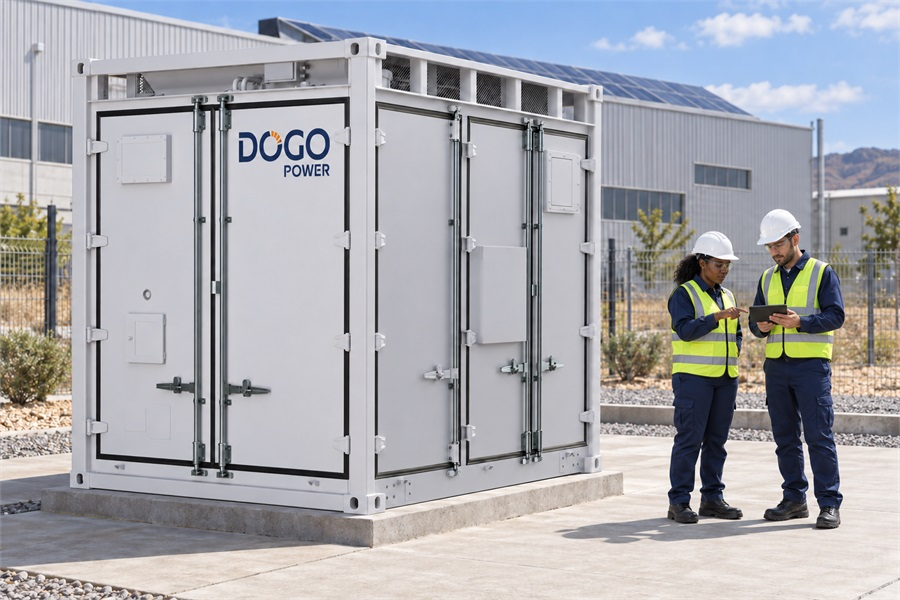
For a C&I microgrid, the storage decision starts with what happens on site: the utility connection is lost, a generator trips or a large motor starts. We assess those conditions alongside everyday energy demand, because the system must have enough stored energy and the right control response for the loads it serves.
Our DG1000-1672kWh-2H0 brings together 1,672 kWh of rated energy capacity, lithium iron phosphate (LFP) batteries and liquid cooling for both battery packs and the power conversion system (PCS). Coordination with PV, generators, loads and the grid allows the configuration to address daily energy flows as well as grid-connected and off-grid operation.
How those components work together matters as much as their individual ratings. In our C&I grid-forming solution, system-level grid-forming coordination links inverter response, battery limits and energy dispatch. The PCS and control configuration must therefore be checked against the site's required voltage and frequency response.
During project assessment, we use simulation to examine those operating conditions. Electromechanical simulation covers system dynamics, electromagnetic transient simulation examines fast electrical behavior, and hardware-in-the-loop testing checks real control hardware against a simulated system. These checks help evaluate how the proposed configuration responds to load changes and supply interruptions before deployment.
What to Specify Before Ordering Grid-Forming BESS
A useful specification describes measurable behavior at the connection point. Before selecting the configuration, we would ask for evidence in five areas:
|
Assessment area |
Evidence to request |
|---|---|
|
Network operating range |
Applicable network conditions, operating modes and boundary assumptions, including credible outages and future changes. |
|
Disturbance performance |
Test scenarios and response results for voltage, phase-angle, frequency and fault events, including current limiting and recovery. |
|
Operating reserves |
SOC range, charging/discharging headroom, service duration and dispatch priorities. |
|
Protection and restoration duties |
Fault-current characteristics, relay coordination, permitted islanding and separate black-start assessments covering auxiliaries and transformer energization. |
|
Acceptance evidence |
Rated power and operating limits, PCS/control configuration, and models and test records matching the supplied hardware, firmware and settings. |
Black start deserves particular care. Maintaining an energized island and restarting a dead network impose different duties. Section 2.4.3 of AEMO's 2023 voluntary specification treats black start as an additional capability involving stored energy, auxiliary supplies and energization requirements. The grid-forming label alone cannot establish readiness for that task.
Likewise, inverter fault current differs from that of synchronous machines. Protection coordination must be checked for the actual installation. Passing generic grid-forming tests does not automatically establish the amount of a specific network service that a project can deliver.
Transgrid's June 17, 2024 draft technical requirements distinguish general grid-forming capability from delivery of its New South Wales-specific stable voltage waveform support service. Procurement should identify both the equipment capability and the evidence needed at the proposed location, using the requirements applicable to that project.
Make Stability Part of the Initial Storage Decision
Grid-Forming BESS is becoming central to how modern power systems maintain stability as conventional generation changes. For your next storage project, assess energy capacity, inverter response and operating reserves together from the start. A clear performance requirement gives every equipment and control decision a stronger foundation.
Turn those requirements into a practical storage plan with DoGo Power. Talk to our team about your C&I or microgrid project and share your connection conditions, load profile, renewable capacity and intended operating modes. We can help assess the DG1000-1672kWh and the supporting control configuration against your site's energy and stability needs.
FAQ
Can a grid-forming BESS keep existing solar inverters running during an outage?
Yes, in a compatible islanded system. With a compatible AC-coupled design, the BESS can establish the local voltage and frequency reference so grid-following PV inverters can continue supplying the microgrid. The exact inverter models, firmware, protection settings and PV power-control method must be compatible; a stable voltage reference alone does not guarantee that the combination will work.
Can multiple grid-forming BESS units operate in parallel?
Yes, with coordinated controls. The units must synchronize and share active and reactive power within their operating limits. Supported PCS combinations, firmware, communications and protection arrangements should be verified before expanding the system; matching nominal voltage alone is insufficient.
What happens when the battery is full but solar output exceeds demand in an islanded microgrid?
Surplus PV output must be reduced. With no utility connection available for export, solar generation must match the loads and permitted battery charging power. Compatible frequency-based controls or coordinated inverter commands can curtail PV output, and the response should be checked for sudden load reductions as well as a full battery.
Can grid-forming BESS replace synchronous condensers?
Sometimes, but not as a universal replacement. Grid-forming batteries can provide voltage support and synthetic inertia, while synchronous condensers may still be needed for mechanical inertia and the fault-current characteristics required by network protection. System studies determine whether a battery, a condenser or a combination can meet the services required at that location.


