


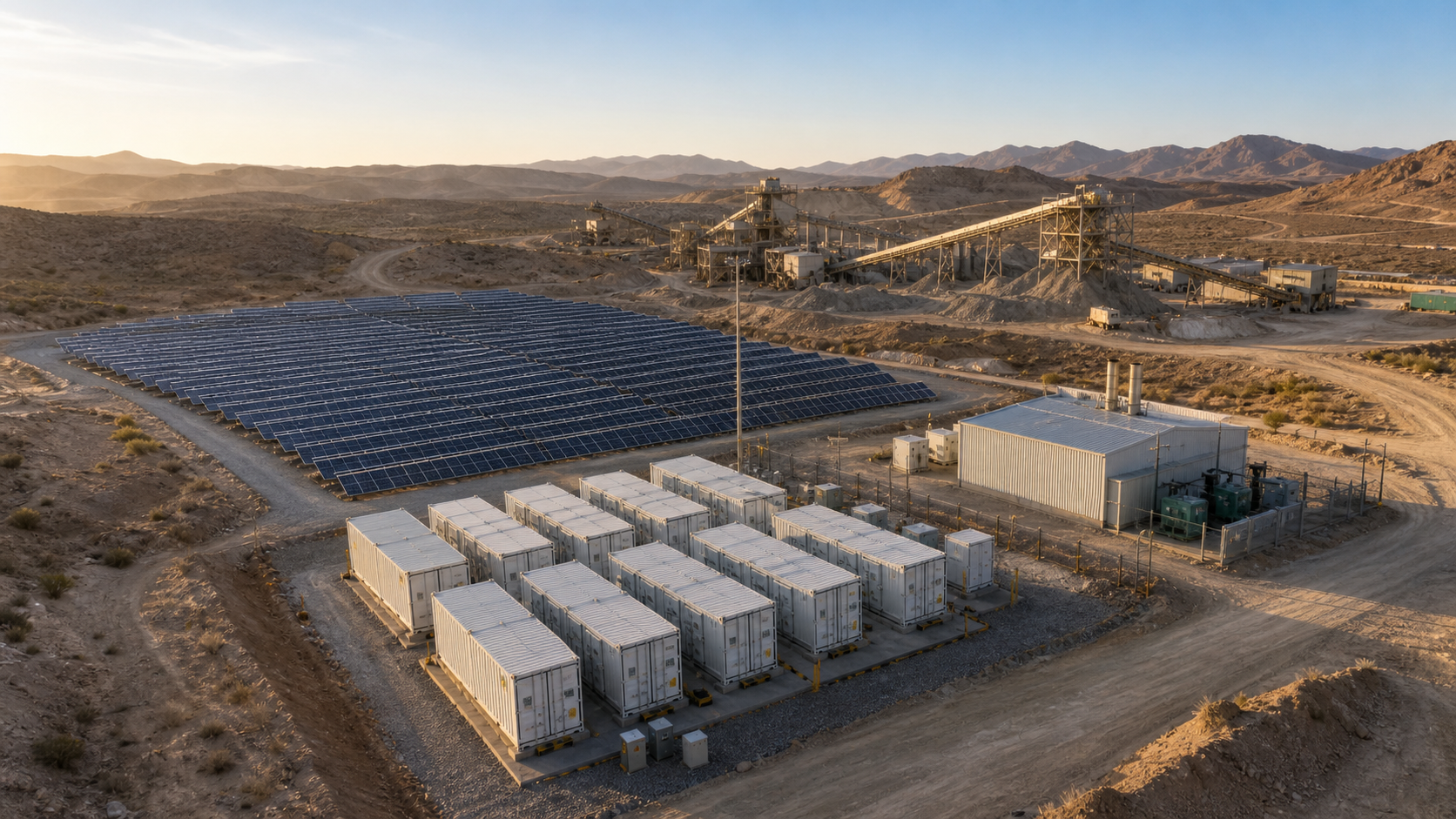
For off-grid mines, islands, industrial sites, and remote communities, cheaper equipment does not always mean lower cost. A diesel generator may have a lower purchase price, but once it starts operating, fuel delivery, fuel storage, maintenance, overhauls, spare parts, on-site staffing, and production losses caused by outages all become part of the real cost.
That is why a comparison between diesel generators and solar-plus-storage systems cannot stop at equipment quotes. The more important questions are: How long will the project operate? How difficult is diesel delivery to the site? Is the load continuous? How much nighttime demand is there? What is the real cost of an outage?
Solar-storage systems usually require higher upfront investment, but their operating costs are more stable. Still, a pure solar-plus-storage configuration is not the best fit for every site. If nighttime load is heavy, or if the site often faces several low-irradiance days in a row, the battery required for reliable supply can become very large and push CAPEX up quickly. For many high-reliability projects, the more practical choice is to combine solar PV, battery energy storage, and diesel backup in a PV-BESS-diesel hybrid microgrid.
In our published Indonesia mining assessment, conventional diesel generation was estimated at USD 0.28-0.40/kWh, while the proposed grid-forming solar-storage solution was estimated at USD 0.12-0.16/kWh. Under a self-investment model, the project could reduce electricity costs by 15%-20% from the first day of operation, with an estimated payback period of 3-5 years. These figures come from a specific project and should not be copied directly to every site.
Why Equipment Purchase Price Is Not Enough
The price of a diesel genset, a battery system, or solar PV modules is usually easy to obtain. The real cost of an off-grid project, however, often appears later in the operating stage.
A more reasonable comparison is to look at how much the project spends over its full life, how much electricity it supplies, and how much outage risk remains. LCOE, or levelized cost of energy, can put initial investment, operating cost, financing cost, and generation volume into one metric. But LCOE also has limits. NREL has noted that it may not fully represent the best solution for a specific project, because site conditions, reliability value, and operating strategy can all affect the result.
This matters even more in off-grid applications. A one-hour outage may not simply mean one hour of lost power. It can stop a production line, interrupt dewatering, affect communications, or even suspend public services.
For early-stage project screening, the cost boundary should be broader:
Lifecycle cost = equipment and EPC cost + fuel and transportation cost + operation and maintenance cost + replacement or expansion cost + financing and taxes - residual value + outage risk cost
When Diesel Generation Still Makes Sense
Diesel generators are not obsolete. They can be deployed quickly, operators are familiar with them, and as long as fuel supply is stable, they can generate power whenever needed. For temporary projects, sites with low annual operating hours, mobile operations, or pure emergency backup, diesel remains practical.
The problem appears after long operating periods. Every kilowatt-hour produced by a diesel generator requires continuous fuel consumption. For a remote mine or island, the key is not the standard fuel price, but the true delivered diesel price at the site. Land or marine transport, loading and unloading, storage, losses, and local supply constraints can push the final cost far above any national average fuel price.
Maintenance is also a long-term cost. Diesel gensets require filter replacement, lubricating oil replacement, cooling-system maintenance, inspections, overhauls, and eventually possible unit replacement. Remote projects also need to consider technician travel, spare-parts inventory, and standby units. Many diesel-only power systems need multiple gensets operating in rotation so one unit can be serviced while another carries the load. They also need enough fuel reserves to handle transport disruptions. These measures improve reliability, but they continue to increase total cost.
Where Solar-Storage and Hybrid Microgrids Create Value
The defining feature of a solar-storage system is that more cost is placed at the beginning of the project. A typical budget includes solar PV modules, battery cabinets or containerized battery systems, PCS, thermal management, protection equipment, switchgear, transformers, control systems, civil works, installation, and commissioning. For a hybrid microgrid, diesel integration and coordinated system control must also be considered.
Once the system is operating, solar PV can reduce daytime diesel generation, while energy storage can shift energy, respond to short-duration peaks, smooth PV fluctuations, and help stabilize power quality. As a result, the project becomes less exposed to fuel-price volatility and operating costs become more controllable.
But batteries are not a one-time configuration that can be ignored afterward. Capacity changes with age, temperature, cycling, and operating range. A financial model should therefore account for battery degradation, augmentation, or replacement in advance.
Pure PV plus BESS is better suited to projects with strong solar resources, relatively predictable loads, and reasonable nighttime autonomy requirements. For continuous industrial loads, the challenge is different: to cover worst-case weather and high nighttime demand, the battery may need to be very large. That raises upfront investment, while part of that capacity may not be fully used on normal days.
The advantage of a PV-BESS-diesel hybrid microgrid is that the system does not need to be pushed to that extreme. Solar PV covers daytime supply, the battery responds quickly to load changes and renewable fluctuations, and diesel covers long periods of low renewable generation or unusually high load. This reduces diesel runtime while retaining reliable backup capability. Dispatch is critical here. Poor control can lead to curtailed PV, ineffective battery cycling, or diesel generators running for long periods in low-efficiency zones.
Which Power Supply Architecture Fits the Site Best?
| Decision factor | Diesel-only power | PV + BESS | PV-BESS-diesel hybrid microgrid |
|---|---|---|---|
| Initial investment | Lower | Higher | Moderate to higher |
| Ongoing fuel pressure | High | Almost none during normal operation | Significantly reduced |
| Maintenance profile | Mainly engine maintenance | Mainly electrical and battery maintenance | Both are involved, but diesel runtime is reduced |
| Main planning risks | Fuel price, transport, overhaul, downtime | Oversized storage, or insufficient autonomy | Integration quality and dispatch strategy |
| Best-fit scenarios | Temporary projects, low utilization, backup power | Good solar resource, controllable load, reasonable autonomy needs | Continuous critical loads at remote sites |
| Main economic advantage | Low entry barrier and dispatchable generation | Stable operating cost | Balances LCOE, fuel savings, and reliability |
This table is only a directional screening tool, not a configuration rule. The final result changes with the load curve, delivered diesel price, solar resource, share of critical load, and financing structure.
By Scenario: How to Choose More Rationally
Mines and mineral processing sites usually have large, continuous loads, and the cost of an outage can be very high. Diesel often needs to be transported over long distances. In this situation, a hybrid microgrid is more likely to show clear value: solar PV and storage reduce everyday diesel consumption, while diesel generators remain available as backup during long periods of insufficient renewable generation. In the Indonesia mining assessment mentioned above, diesel generation cost was USD 0.28-0.40/kWh, while the proposed microgrid solution was USD 0.12-0.16/kWh. Each mine still needs a separate calculation based on its own load profile, fuel logistics, financing conditions, and solar resource.
Remote islands and communities are also often constrained by fuel supply, but their load priorities are more complex. Water treatment, clinics, communications, cold chains, and public facilities usually need priority protection, while some non-critical loads can be shifted or temporarily reduced. Classifying loads first often reduces unnecessary storage and backup capacity.
Industrial parks and factories in weak-grid areas can use solar PV and energy storage for demand control, peak shaving, power quality improvement, and backup power. Diesel generators can remain in the system, but their role shifts from primary power source to long-duration backup.
For short-term construction, exploration, or seasonal operations, diesel may still be the better choice. If the project duration is too short, fuel savings may not have enough time to recover the additional investment before the project ends. Frequent equipment relocation can also reduce the attractiveness of a hybrid system. In general, the longer the operating period and the harder the fuel logistics, the more seriously a hybrid solution should be evaluated.
Turning the Cost Comparison into an Executable Plan
To make the economics clear, experience-based estimates are not enough. It is better to build the model with real operating data. DoGo Power's EcoSizing Micro-Grid Sizing Tool uses 8,760 hours of irradiance and load data to optimize solar PV, energy storage, diesel capacity, and the corresponding operating strategy.
It does more than calculate system size. It also performs lifecycle simulation, incorporating equipment aging, battery capacity compensation, and other factors, then outputs capacity configuration, economic and reliability analysis, financial tables, and operating strategy. Our solution example also notes that this design process can help reduce CAPEX by more than 20%. In other words, modeling is not a procedural step; it directly affects investment judgment before procurement. The output indicators include NPV, IRR, and LCOE.
During operation, the Energy Management and Control System aggregates data from PV inverters, PCS, PMS, BMS, and site loads. It uses topology views to show the energy flow among solar PV, energy storage, diesel, grid, and on-site loads. It also supports forecasting, intelligent dispatch, power-station monitoring, historical analysis, alarms, and operating reports. In our Indonesia mining case, AI-based dispatch was reported to improve overall project returns by 10%. Dispatch quality should therefore not be treated only as a control-system issue. It is part of the financial result.
At the power-control layer, DG-PMS1000 and DG-PMS2000 coordinate energy flow among solar PV, BESS, diesel generator sets, and the grid. They support black start, PV-storage coordination, demand control, anti-backflow control, and time-of-use tariff operation. The DG-SMC1000 microgrid cabinet supports grid-connected operation, off-grid operation, and smooth switching, allowing multiple power resources to operate together.
For mines, islands, and renewable power stations, DoGo Power provides energy storage solutions that support grid stability, renewable integration, and reliable power delivery in demanding energy environments. Smaller DG1000 configurations are better suited to commercial and industrial energy storage projects. At the hardware level, an integrated energy storage system brings together batteries, PCS, thermal management, BMS, and fire protection. Factory pre-integration and quick-plug design can reduce on-site construction and commissioning pressure, which is especially important for remote sites.
How Much Can a Hybrid Microgrid Save?
Some of our published cases can serve as early references. In the Indonesia mining assessment, the proposed microgrid solution had a generation cost of USD 0.12-0.16/kWh, compared with USD 0.28-0.40/kWh for conventional diesel. Under a self-investment model, the project could reduce electricity costs by 15%-20% from the first day of operation, with an estimated payback period of 3-5 years.
Other scenarios show a similar savings logic. A mining project in Latin America achieved a renewable energy replacement rate of more than 90% and saved more than USD 1.5 million in fuel costs each year. A 5 MW / 10.72 MWh factory rooftop project in Mali reduced electricity cost by about 30%. An industrial park in South Africa achieved 18% annual electricity-bill savings with EMS support.
These numbers cannot be transferred directly to another project, but they show one point clearly: to understand how much an alternative power solution can save, diesel runtime, delivered diesel price, load curve, solar resource, battery degradation, and dispatch strategy must be calculated in the same model.
What to Prepare for a Lifecycle Cost Assessment
A reliable assessment should not begin with "what equipment do we want to buy." It should begin with site data. In most cases, the following inputs are needed:
- A full-year load curve recorded hourly or at higher resolution
- The share of critical load and the maximum acceptable interruption time
- Site irradiance and seasonal weather data
- Delivered diesel price, transport route, and fuel-storage constraints
- Existing diesel generator capacity, fuel-consumption curve, operating hours, and maintenance records
- Ambient temperature, altitude, installation space, and electrical topology
- Required supply duration during low-irradiance periods
- Project life, financing structure, discount rate, tax assumptions, and target return
With these inputs, diesel-only power, PV plus BESS, and PV-BESS-diesel hybrid solutions can be compared on the same basis. The result should not only provide a "recommended solution." It should also show the energy balance, diesel runtime, curtailed PV, battery usage, replacement assumptions, reliability performance, annual cash flow, LCOE, NPV, IRR, and payback period.
Conclusion
Diesel generators remain suitable for short-term projects, low operating hours, mobile loads, and emergency backup. Solar-storage systems are better suited to projects with a long operating life, good solar resource, and load curves that do not force excessive battery sizing. For mines, islands, remote communities, and industrial facilities with high shares of continuous critical load, a PV-BESS-diesel hybrid microgrid is often the more balanced option: it reduces fuel dependence, controls lifecycle cost, and keeps reliable backup capability.
The final choice should not be based on a simple statement such as "diesel is cheaper" or "solar-storage saves more." It should return to site data. Only when real load, irradiance data, diesel logistics, battery aging, system control, financing conditions, and reliability requirements are calculated together can the value of renewable energy be understood and the role of diesel backup be judged accurately.
If you already have a load curve, delivered diesel price, irradiance data, autonomy requirement, and financing assumptions, you can start with a lifecycle cost assessment. That will make it easier to see whether diesel-only power, solar-plus-storage, or a PV-BESS-diesel hybrid microgrid is the better fit for the current project.


